


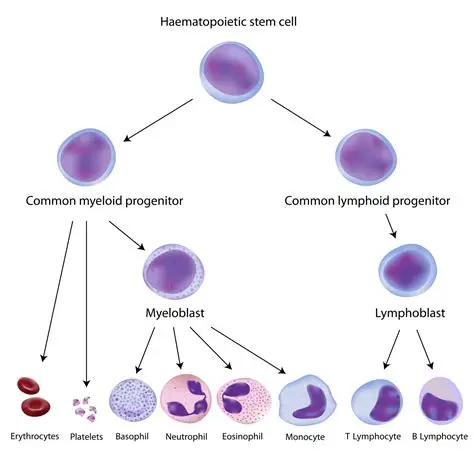
Abstract: Hematopoietic stem cells(HSCs) are pluripotent stem cells mainly resident in bone marrow. Long-term self-renewal enables differentiation into various mature blood cells. Differentiation pathway forms two kinds of progenitor cells: common lymphoid progenitor(CLPs) and common myeloid progenitor(CMPs). CLPs further grow into T/B/NK cell. CMPs are differentiated into monocytes/macrophages, neutrophils, eosinophils, basophils, red blood cells, megakaryocytes(platelet production) and some dendritic cells, together establishing immune and blood system. Hierarchical recognition and separation of HSCs and multipotent progenitor cells(MPPs) are conducted via flow cytometry sorting technique, utilizing various specific surface antibodies and hematopoiesis CD markers.
Keywords: Hematopoiesis CD Markers, Flow Cytometry, Hematopoietic stem cells, Cell sorting
1. Sources and Function of HSCs
HSCs are mainly found in bone marrow, peripheral blood, and umbilical cord blood. Traditionally, bone marrow(e.g. femur, sternum, ribs) is the key source of HSCs and widely applied in transplantation; Concentration of HSCs in umbilical cord blood is about 10 times higher than bone marrow, capitalizing on advantages like strong proliferation, better immune compatibility and low rejection risk etc; Mobilized peripheral blood can also collect sufficient HSCs for transplantation. In the treatment of leukemia, lymphoma, multiple myeloma, homing of infused HSCs to bone marrow reestablishes hematopoietic and immune system. Mini-transplant can also produce billions of new blood cells every day, efficiently restoring patients' blood function.
2. Common Markers for Sorting Hematopoietic Stem/Progenitor Cells(HSPC)
Species differences are obvious in sorting markers for human and mouse HSPC. Human HSCs mainly depend on CD34⁺CD38⁻ phenotype. Long-term hematopoietic stem cell(LT-HSC) is usually CD34⁺CD38⁻CD90⁺CD45RA⁻, and can be further enriched based on high ALDH activity; Expression frequency of CD34 in bone marrow, umbilical cord blood and peripheral blood is 1-5%, 1% and 0.1% respectively. Mouse HSPC focuses on Lin⁻c-Kit⁺Sca-1⁺(KSL). Its LT-HSC is usually CD34⁻Flk2⁻(CD135⁻). Sca-1 is valid in strains like C57BL/6. Expression in BALB/c is lower. Alternatively, SLAM marker(Lin⁻CD48⁻CD150⁺) is suitable for various strains. Besides, mouse HSC can be further enriched via CD201⁺CD34⁻CD135⁻ or low uptake of Hoechst/Rh123(side population). These differences reflect effects of species evolution on expression of surface antigen.
3. FACS and Surface Markers
Key markers can further improve purity of LT-HSCs, including: CD34(common marker for stem/progenitor cells), CD38(HSCs are negative or lowly expressed), CD45RA(negative for enriching undifferentiated HSCs), and CD90(Thy1) and CD49f(integrin α6).
The final target population is accurately defined as lin⁻CD34⁺CD38⁻/lowCD45RA⁻CD90⁺CD49f⁺, separating LT-HSCs with high purity.
4. FACS Procedure: From Samples to Cell Purification
The assay procedure below is suitable for separating HSCs and MPPs from mobilized leukapheresis products (mob LPs):
4.1. Separation of Peripheral Blood Mononuclear Cells(PBMC)
Conduct density gradient centrifugation with Pancoll(density: 1.077 g/mL).
Gently layer diluted leucocytic samples on the top of Pancoll. Centrifuge at 400×g for 30min(room temperature without brake).
Collect PBMCs at the interface. Wash twice with PBS buffer to remove residual platelets.(Centrifuge at 200×g at 20℃ for 10min).
4.2. Magnetic-activated cell sorting(MACS) for CD34⁺ Cell
Label PBMCs with CD34 MicroBeads UltraPure reagent. Incubate for 30min at 4℃.
After filtering with 70 μm sieve, positively sort through LS Columns on a QuadroMACS separator. Then, collect CD34⁺ cell.
4.3. Antibody Staining Steps
4.3.1. Biotin-labeled Antibody Staining(Removal of Non-target Mature Cells)
Antibody combinations include CD2, CD3, CD14, CD16, CD19, CD56, CD235a; Add specific volume of antibodies into 5×10⁶ cell. Incubate for 15min at 4℃ in the dark; After washing with PBS buffer, resuspend in cell staining buffer(K079).
4.3.2. Fluorescence-labeled Antibody Staining
Antibody combinations(every 5×10⁶ cells): eF510(2 μL), CD45RA-BV450(5 μL), CD90-PerCP-Cy5.5(5 μL), CD49f-PE-Cy5.5(2.5 μL), CD34-APC(2.5 μL), CD38-red 780(5 μL); Incubate for 30min on the ice in the dark; After washing with PBS buffer, resuspend in MACS buffer.
4.4. Setting of Sample Control
FMO control(Fluorescence Minus One) is used for gating reference. Single-stained control(compensation beads or positive cells) helps compensation correction in spectral unmixing.
4.5. Sorting Setting and Execution during FACS
Optimize drop delay and break-off with 70 µm nozzle.
Adjust voltage of PMT with unstained cells.
Gating strategies are specified as follows: removal of debris(FSC-A vs SSC-A) → removal of doublets(FSC-A vs FSC-H) → living cells(eF506⁻) → lineage-negative(lin⁻) → CD34⁺CD38⁻/low → CD45RA⁻ → divide according to expression of CD90 and CD49f.
Finally, select 4 populations: LT-HSCs(lin⁻CD34⁺CD38⁻CD45RA⁻CD90⁺CD49f⁺) and three kinds of MPP subpopulations.
4.6. Validation after Sorting
Reanalyze sorting products via purity mode, keeping the purity higher than 95%.
Sorted cells are immediately used in downstream functional assay to keep the biological activity.
5. Conclusion
This article reveals HSC purification is not equivalent to absolute purity. Heterogeneity and restrictions of NSG mouse model still require for deeper analysis via single-cell multi-omics(e.g. CITE-seq).
| Recommended Products | |
| Cat.No | Product Name |
| K124 | FineTest® Violet510 |
| FV450-30153 | FineTest® Violet 450 Anti-Human CD45RA Antibody(HI100) |
| PCP55-30069 | PerCP-Cy5.5 Anti-Human CD90 Antibody(5E10) |
| APC-30071 | APC Anti-Human CD34(581) |
| FR780-30238 | FineTest® Red 780 Anti-Human CD38 Antibody(AT13/5) |
REFERENCES
[1]CD99 promotes self-renewal in hematopoietic stem cells and leukemia stem cells by regulating protein synthesis, PMID: 40700577.
[2]Reversing lysosomal dysfunction restores youthful state in aged hematopoietic stem cells, PMID: 41289991.