


Abstract: Sharing a 24.7% amino acid sequence identity and receptor structure highly similar with IL-10 family members, Interleukin-26(IL-26) is categorized into IL-10 cytokine member. Roles of IL-26 in immunoregulation and host defense are important.
Keywords: Interleukin-26, Immunoregulatory Cytokine, Autoimmune Diseases, Targeted Therapy
1. IL-26: An Antimicrobial factor Bridging Innate and Adaptive Immunity
IL-26 is the innate antimicrobial factor derived from human Th-17 cells, acting as the cationic amphipathic protein. It can directly kill extracellular bacteria via forming membrane pore. Induced host cell death can increase immune sensing. Besides, Th-17 derived IL-26 can bind with its own DNA and bacterial DNA to form the complex, released with cell lysis. This complex can independently activate TLR9 of plasmacytoid dendritic cells, further triggering production of type I interferon. Roles in bridging innate and adaptive immunity are important.
2. IL-26: A Multifaceted Immunoregulatory Cytokine
IL-26 has various immunoregulatory functions. It can regulate cytokine expression, e.g. stimulation of highly expressed IL-8 in keratinocyte, up-regulation of colorectal cancer cells(CD54), inhibition of IL-10 secretion. For B cells, functions of IL-26 is dependent on microenvironment: Inhibition of immunoglobulin production separately or together with anti-CD40. Synergistic effects of IL-4 promote IgG production. Besides, IL-26 can bind with heparin but is also inhibited. Receptor distribution is specific. IL-10R2 is widely expressed. IL-20R1 is only restricted in tissues like skin, heart etc. During induction of inflammation, IL-26 stimulates release of pro-inflammatory factors by marrow cells, and secretes IL-1β via monocytes. Polarization of memory CD4+T cells into Th17 greatly amplify inflammatory response.
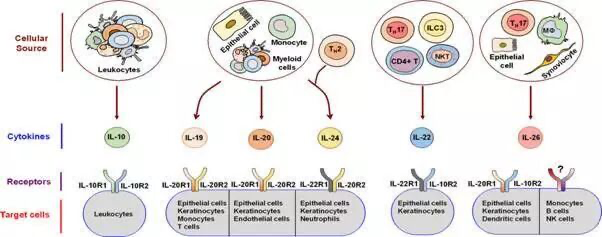
3. Roles of IL-26 in Immunity
IL-26 has obvious pro-inflammatory features, playing an important role in chronic inflammation and pathogenesis of autoimmune diseases. Genetic researches show genetic polymorphisms of IL-26 are closely associated with disease susceptibility(e.g. multiple sclerosis, rheumatoid arthritis etc). Besides, in Th17 cell mediated autoimmune diseases(e.g. Crohn's disease, psoriasis, ANCA-associated vasculitis etc), level of IL-26 across patient's circulation and tissues obviously increases. The abnormal high expression further exacerbates inflammatory response and tissue damage. Thus, IL-26 is the important cytokine for driving disease progression, and also potential target for disease treatment.
4. Roles of IL-26 in Autoimmune Diseases
Roles of IL-26 in various autoimmune diseases are complex and important. In multiple sclerosis(MS), high expression in patient's body shows pro-inflammatory potentiality. Researches reveal IL-26 also improves blood-brain barrier integrity and relieves symptoms in animal model. As the key pro-inflammatory mediator in rheumatoid arthritis(RA), IL-26 forms positive feedback cycle with IL-1β. Induced differentiation of M1 macrophage and promoted production of osteoclast apparently exacerbate inflammation and bone destruction. In inflammatory bowel disease(IBD), IL-26 is mainly secreted from Th17 cell. Activated multi-signaling pathways induce release of pro-inflammatory factors. Genetic polymorphisms are relevant to disease susceptibility and decreased bacterial clearance. Besides, in psoriasis, IL-26 drives expression of chemokine and recruits immunocytes, promoting angiogenesis and epidermal hyperplasia. Neutralizing antibody therapy shows better prospects. Above all, IL-26 is the important pathogenic driver and potential target of these diseases.
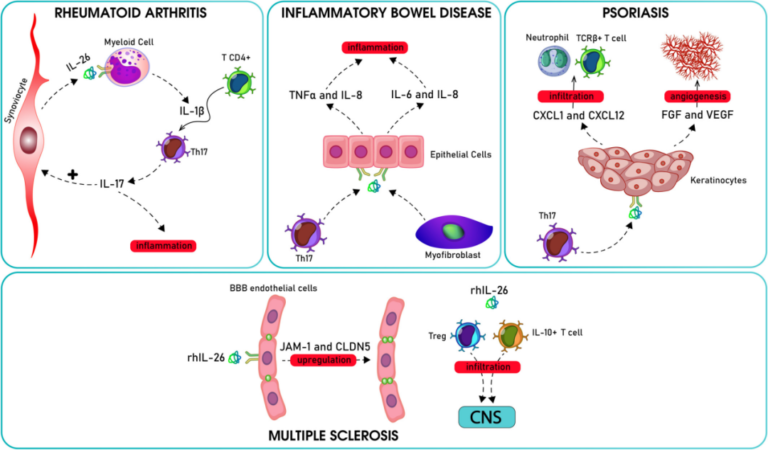
5. New Drug Development of IL-26 in Autoimmune Diseases
Avva Pharmaceuticals Ltd has developed IL-26 inhibitor for preclinical research of psoriasis. Positive data are expected to validate therapeutic value of IL-26.
|
Recommended Products |
|||
|
Cat.No |
Product Name |
Host |
Mol. Weight |
|
Recombinant Human IL-26 |
E.Coli |
16.4 kDa |
|
|
Cat.No |
Product Name |
Sensitivity |
Range |
|
Human IL26 (Interleukin-26) ELISA Kit |
9.375pg/ml |
15.625-1000pg/ml |
|
REFERENCES
[1]Th17 cells with regulatory phenotype are the main IL-17F and IL-26 producers in palmoplantar pustulosis, PMID: 40985896.
[2]IL-26 from innate lymphoid cells regulates early-life gut epithelial homeostasis by shaping microbiota composition, PMID: 41125850.