


Abstract: Gout is the systemic inflammatory arthropathy during which abnormal metabolism of purine induced hyperuricemia promotes deposition of MSU crystal(monosodium urate) in joints and soft tissues. Symptoms of acute attacks are MSU crystal induced severe sterile arthritis. Recurrent development becomes chronic gout. Tophi with chronic inflammation and tissue damage induce arthralgia, deformity, and functional impairment. Effects on activities of daily life and life quality are great.
Keywords: Gout causes and treatment, inflammatory arthritis, Uric acid lowering, Targeted therapy
1. Symptoms of Gout
Gout includes three phases: a. Asymptomatic phase: hyperuricemia and obscure arthral symptoms; b. Acute phase: acute and self-limited monoarthritis with intense redness, swelling and pain, usually involved in the first metatarsophalangeal joint; c. Chronic phase: poor control of uric acid forms tophi, resulting in joint destruction and deformity etc. Complications include renal calculi, uric acid nephropathy, renal failure, cardio-cerebrovascular diseases.
2. Causes of Gout Disease
Gout is induced by many factors: intake of high purine food(e.g. animal organs, seafood, alcohol, soy products and fungi etc); high risk for family genetic history; increase or decrease of body weight affects uric acid metabolism; Besides, some drugs like diuretics, chemotherapeutic drugs can increase serum uric acid, resulting in a high risk of gout.
3. Molecular Mechanism of Acute Gout
Acute gout is the MSU crystal induced sterile necrotic inflammation. MSU crystal induces programmed cell necrosis via activating RIPK-1/RIPK-3/MLKL pathway. Damage of cell membrane induces epithelial cell death, releasing DAMPs and alarmin. After uptake of crystal, phagocytes activate NLRP3/IL-1β inflammasome to promote secretion of IL-1β and IL-1α. Effects on IL-1R release a large amount of pro-inflammatory factors and recruit neutrophils. Crystal exposure induces necroptosis of neutrophils and forms NETs, releasing toxic substances to accelerate inflammatory response(e.g. protease, histone) and form self-amplifying inflammatory cycle.
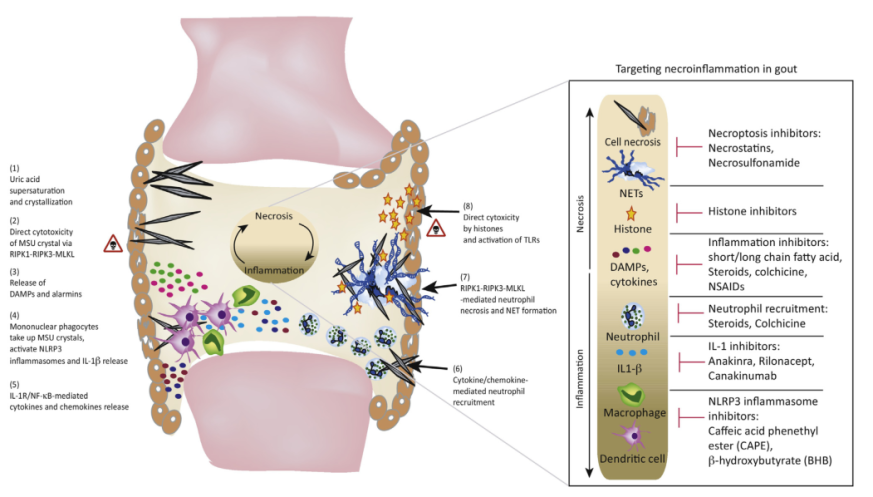
4. Molecular Mechanism of Chronic Gout
Chronic gout is represented by formation of tophi. Perpetuating MSU crystal induces aggregation of a large number of neutrophil extracellular traps(NETs) to form aggNETs. Released protease can degrade pro-inflammatory factors, promoting conversion of inflammation to non-inflammatory clearance. Macrophages surround crystal and aggNETs. Phagocytosis but fails to completely remove. Fusion-formed epithelioid cells and multinuclear giant cells produce foreign body granuloma. The structure of chronic granuloma restricts crystal diffusion. The persistently induced tissue remodeling causes erosion of surrounding bone and damage of soft tissues, promoting joint deformity and dysfunction.
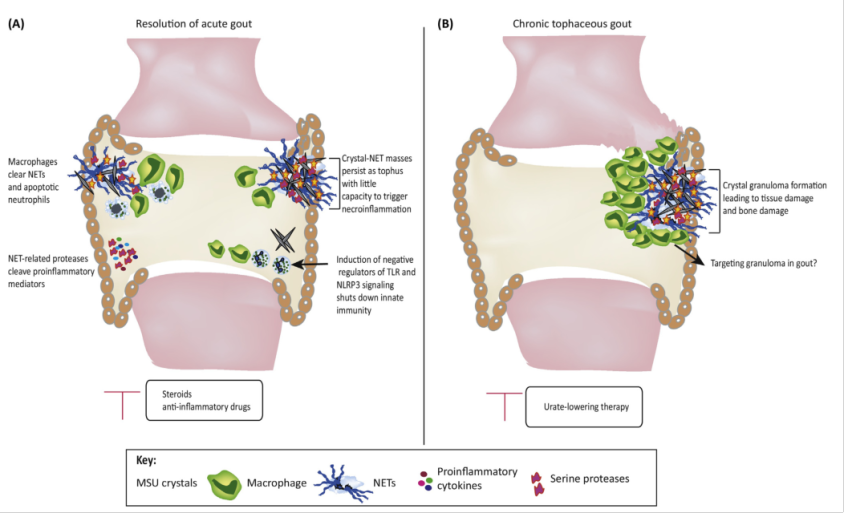
5. Spontaneous Relief of Gout
Spontaneous relief of acute gout is involved in multiple anti-inflammatory mechanisms. Neutrophils are involved in initiation and resolution of inflammation and promote lipid catabolism. Increase of anti-inflammatory cytokines(e.g. IL-1Ra, IL-10, TGF-β1 etc) inhibit IL-1 and TNF-α pathway. PYD/CARD protein, sTLR-4 and Clec12a negatively regulate inflammasome and TLR signal, inhibiting activation of NLRP3. IL-37 and HDL can reduce infiltration of neutrophils. Phagocytosis of apoptotic neutrophils by macrophages promotes release of TGF-β1 and IL-1Ra. aggNETs degrade inflammatory mediators. Exosomes also inhibit production of IL-1β, promoting resolution of inflammation.
6. Targeted Drugs
Anti-gout agents include acute-phase drugs for control of acute inflammation(e.g. colchicine, Canakinumab) and urate-lowering drugs for inhibition of uric acid or stimulation of excretion following remission of the acute phase. Currently, 11 urate-lowering drugs have been approved worldwide, 7 of which are from China. Key mechanisms include inhibition of xanthine oxidase, URAT1 and recombinant urate oxidase.
Xanthine oxidase inhibitors(e.g. allopurinol, febuxostat) can reduce uric acid synthesis. Risk for hypersensitivity or angiocardiopathy also exists. URAT1 inhibitors(e.g. Benzbromarone, Dotinurad) promote uric acid excretion. Combined therapy may be required for decrease hepatotoxicity. Uric acid oxidases(e.g. pegloticase) are used for refractory gout, and rapidly lower uric acid. There is a risk of allergies. Safety restrictions are associated with various drugs, depending on clinical risks and benefits.
Development of new anti-gout agents focuses on mature targets like URAT1 and IL-1 etc. Firsekibart has been submitted for assessment, and is expected to be the first domestic IL-1 inhibitor for acute gout. Some innovative drugs have been in clinical trial, e.g. THDBH-151(dual-target inhibitor) and HZN-457(siRNA drug).
| Target | Antibodies | Recombinant Proteins | ELISA Kits |
| IL-6 | IL-6 antibody | IL-6 recombinant protein | IL-6 ELISA Kit |
| IL-1β | IL-1β antibody | IL-1β recombinant protein | IL-1β ELISA Kit |
| TNF-α | TNF-α antibody | TNF-α recombinant protein | TNF-α ELISA Kit |
| IL-10 | IL-10 antibody | IL-10 recombinant protein | IL-10 ELISA Kit |
| IL-1Ra | IL-1Ra antibody | IL-1Ra recombinant protein | IL-1Ra ELISA Kit |
| TGF-β1 | TGF-β1 antibody | TGF-β1 recombinant protein | TGF-β1 ELISA Kit |
| sTREM-1 | sTREM-1 antibody | sTREM-1 recombinant protein | sTREM-1 ELISA Kit |
| LEP | LEP antibody | LEP recombinant protein | LEP ELISA Kit |
| CRP | CRP antibody | CRP recombinant protein | CRP ELISA Kit |
| ADP | ADP antibody | ADP recombinant protein | ADP ELISA Kit |
REFERENCES
[1]Efficacy and Safety of Dotinurad Versus Febuxostat for the Treatment of Gout: A Randomized, Multicenter, Double-Blind, Phase 3 Trial in China, PMID: 40417858.
[2]Deconstruction of tophi and synovium defines SPP1+ macrophages involved in extracellular matrix remodelling in gout, PMID: 41107120.