


Abstract: Autoimmune diseases(AID) are derived from abnormal attack of immune system against autoantigen. Typical case is systemic lupus erythematosus(SLE). The pathogenesis is involved in over-activation and decreased immune tolerance of B and T cell. In the subpopulation of CD4⁺ T cell, roles of Th17 and Treg cell in AID and inflammatory process are important. TGF-β together with IL-6 or IL-21 can induce naive CD4⁺ T cell to express transcription factor(e.g. RORγt). Differentiation into Th17 cell secretes pro-inflammatory factor IL-17. Treg cell antagonizes Th17 reaction and maintains immune balance. Flow cytometry for T cell analysis is specified below.
Keywords: T cell analysis, Flow cytometry, Th17/Treg, Immune balance, Autoimmune diseases
1. Overview of Th17 and Treg Cell
Th17 and Treg cell are important subpopulations of CD4⁺ T helper cell. Their roles in immune regulation and inflammatory response are important and opposite.
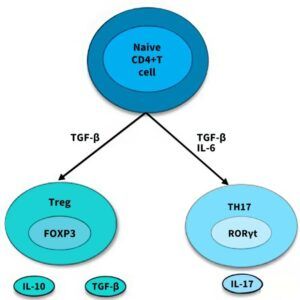
Th17 cells are differentiated by from naive CD4⁺ T cells, following involvement of cytokines(TGF-β with IL-6 or IL-21). Characteristic transcription factor is RORγt. Secretion of pro-inflammatory factors defenses against extracellular pathogens, e.g. IL-17A/F, IL-21, IL-22 etc. Over-activation can drive autoimmunity and chronic inflammation.
Treg cells(Regulatory T cells) are differentiated from exclusive effects of TGF-β, dependent on transcription factor Foxp3. Immunosuppression inhibits activation of effector T cells via secretion of IL-10, TGF-β and cell-cell contact(e.g. CTLA-4), maintaining tolerance and immune homeostasis.
Their differentiation pathways are mutually antagonistic. Functions are dynamically balanced. Imbalance is closely related to various autoimmune diseases.
1.1. Interaction between Th17 and Treg Cell
Th17 and Treg cell are derived from naive CD4⁺ T cell. The differentiation is regulated by microenvironmental cytokines. Exclusive effects of TGF-β promote differentiation of Treg to express Foxp3. TGF-β with IL-6 or IL-21 induces expression of RORγt and drives production of Th17. Th17 cell secretes pro-inflammatory factors(e.g. IL-17) to mediate inflammation and autoimmune injury; Treg cell inhibits Th17 reaction and maintains immune tolerance via secreting IL-10 and TGF-β and cell-cell contact. Their functions are mutually antagonistic, showing plastic changes. In inflammatory environment, Treg may be differentiated into Th17 like cells. Imbalance of Th17/Treg(especially over-activation of Th17 or decrease of Treg function) is the key pathogenesis of various autoimmune diseases.
2. Molecular Mechanisms for Th17/Treg Imbalance
Key molecular mechanisms are involved in cytokine signaling, mutual exclusion of transcription factors, epigenetic regulation and metabolic reprogramming. TGF-β is the common basis for differentiation. Activation of STAT3 by inflammatory factors(e.g. IL-6, IL-21) induces the expression of RORγt, promoting differentiation of Th17 and inhibition of key Treg transcription factor(Foxp3). During undetected inflammation, TGF-β induces Foxp3 to promote production of Treg via SMAD pathway. RORγt and Foxp3 inhibits with each other. Besides, promoter region of Foxp3 and Il17 is regulated by DNA methylation and histone modification, affecting cell stability. During metabolism, glycolysis and HIF-1α promote Th17. Fatty acid oxidation and activation of AMPK is good for Treg. These mechanisms induce over-activation of Th17 and functional deficiency of Treg in autoimmune diseases.
3. Flow Cytometry for T Cell Analysis
3.1. Flow Cytometry for Treg Cell
Treg(Regulatory T cell) is usually identified as CD4⁺CD25⁺CD127low/neg with highly expressed CD25 and lowly expressed CD127. The key identifiable marker is intracellular transcription factor Foxp3. Some researches also detect Helios to distinguish natural and induced Treg(nTreg/iTreg). Detection of Foxp3 in the nucleus should use specific fixation/permeabilization kit, keeping fluorescent signal stable during operation.
3.2. Flow Cytometry for Th17 Cell
Th17 cell belongs to subpopulation of CD3⁺CD4⁺T cell. Functional characteristics are secretion of IL-17A, which is usually detected by intracellular staining. Before detection, stimulate cells for 4-6h with PMA/ionomycin. Add protein transport inhibitor(e.g. Brefeldin A) to prevent secretion of cytokines. Besides, detect subsidiary targets like IL-17F, IL-21 or IL-22. Some solutions also try to detect key transcription factor RORγt. Gating analysis for surface markers only needs CD3 and CD4.
FMO or isotype control setting for cell detection can ensure accurate result.
| Recommended Products | |||
| Species | Cell Populations | Flow Cytometry Antibody Combination | Cat.No |
| Human | T/B/NK cell populations detection | CD45-PerCP | PCP-30039 |
| CD3-FITC | FITC-30004 | ||
| CD16-PE | PE-30061 | ||
| CD56-PE | PE-30008 | ||
| CD19-APC | APC-30066 | ||
| Human | Thl/Th2 cell populations detection | CD3-PerCP/Cyanine5.5 | PCP55-30004 |
| CD4-FITC | FITC-30005 | ||
| IFN-γ-PE | PE-30053 | ||
| IL4-APC | APC-30043 | ||
| Mouse | Thl/Th2 cell populations detection | CD3-PerCP/Cyanine5.5 | PCP55-30002 |
| CD4-FITC | FITC-30128 | ||
| IFN-γ-PE | PE-30074 | ||
| IL4-APC | APC-30026 | ||
| Human | Treg cell populations detection | CD4-FITC | FITC-30005 |
| CD25-PE | PE-30035 | ||
| CD3-PerCP-Cy5.5 | PCP55-30004 | ||
| CD127-FineTest®647 | F647-30033 | ||
| Mouse | Treg cell populations detection | CD4-FITC | FITC-30128 |
| CD25-APC | APC-30017 | ||
| FOXP3-PE | PE-30111 | ||
REFERENCES
[1]Notch3 destabilizes regulatory T cells to drive autoimmune neuroinflammation in multiple sclerosis, PMID: 41043415.
[2]Regulatory T cell therapy promotes TGF-β and IL-6-dependent pro-inflammatory Th17 cell generation by reducing IL-2, PMID: 40818959.
[3]Gut Microbial Metabolite Butyrate Regulates Treg/Th17 Cell Balance to Alleviate Diabetic Periodontitis, PMID: 40983096.
[4]Inhibition of HMGB1/NF-κB signaling restores Th17/Treg balance via dendritic cell modulation in liver transplant rejection, PMID: 40977677.