


Abstract: PARP(Poly (ADP-ribose) polymerase) is the nucleoprotein found in eukaryotic cells, involved in DNA damage repair, gene expression regulation and apoptosis etc. PARP1 is one of the most completely studied members. Roles in DNA damage response(DDR) are important, maintaining genomic stability and cell health. Functions of PARP in various important biological processes show its significance in cells. Currently, PARP inhibitors(PARPi) have been approved for various tumor treatments, e.g. Olaparib, Niraparib and Rucaparib are used in BRCA mutation induced-ovarian cancer treatment.
Keywords: PARP Inhibitor, Targeted Therapy, Tumor Treatment, Drug Effects, Combined Therapy
1. Structure and Functions of PARP
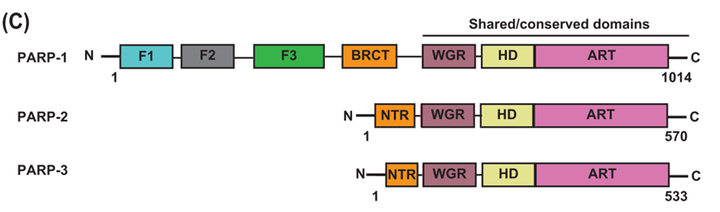
There are 17 PARP family members, including PARP1, PARP2 and PARP3 etc. Their roles in DNA damage repair are important. E.g. PARP1 consists of three components: DNA-binding domain(DBD) is responsible for recognizing DNA breakage and recruiting repair proteins; Auto-modification domain(AD) mediates protein-protein interaction and regulates activity; Catalytic domain(CAT) catalyzes hydrolysis of NAD+. Transfer of ADP-ribose to the target protein forms Poly (ADP-ribose) chain, involved in the repair process.
2. Binding Mode and Mechanism of PARPi
2.1. Binding Mode of PARPi
Chemical structures of PARP inhibitors are similar, including ring-opened amide(e.g. Niraparib), pyridazinone(e.g. Olaparib, Talazoparib, Fluzoparib) or lactam(e.g. Rucaparib, Pamiparib). Exocyclic or cyclized amide groups can form hydrogen bond with amino acid of PARP. Aromatic ring conjugated with amide can react with nearby tyrosine and histidine residues to result in π-π stacking interaction and improve binding ability.
2.2. Mechanism of Action of PARPi
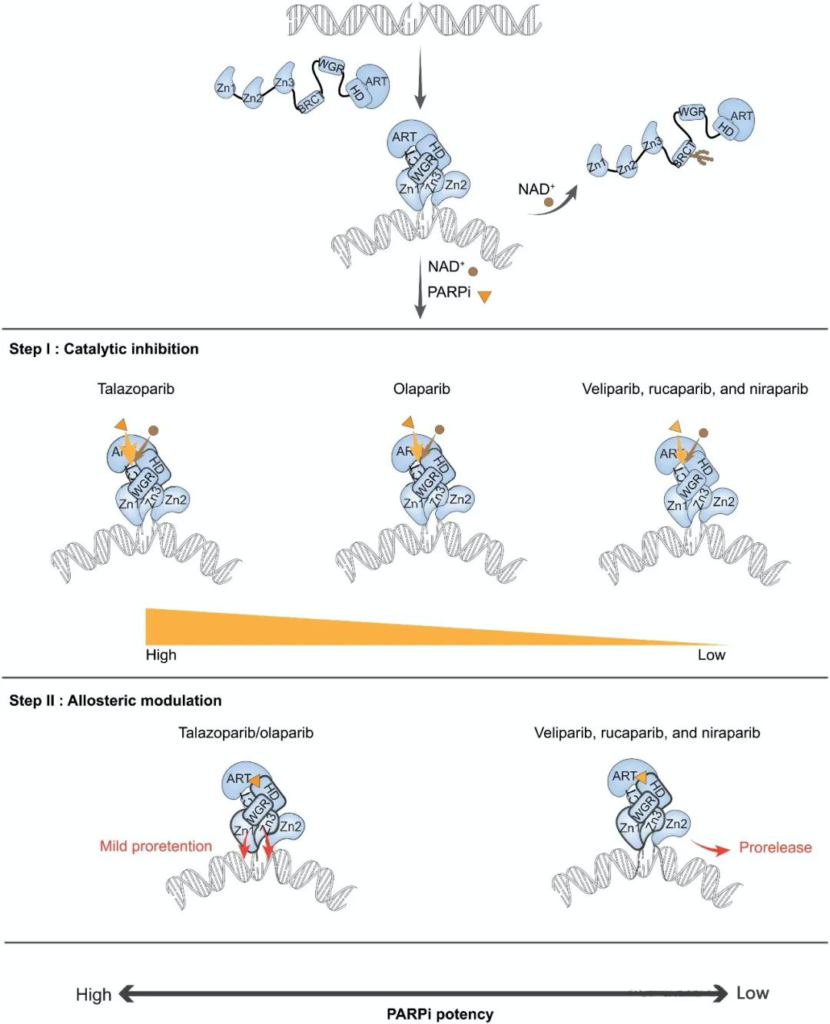
PARPi take effects via two steps: First, competitively bind with sites of NAD+ and inhibit catalytic activity; Second, allostery improves PARP-DNA binding, and prevent DNA repair via extending retention at the injury site. Intensities of different drugs are varied, e.g. Talazoparib is stronger in catalytic inhibition and induction of PARP retention. Niraparib and Rucaparib are weaker. The differences affect therapeutic effect and selectivity.
3. Roles of PARPi in Tumor Treatment
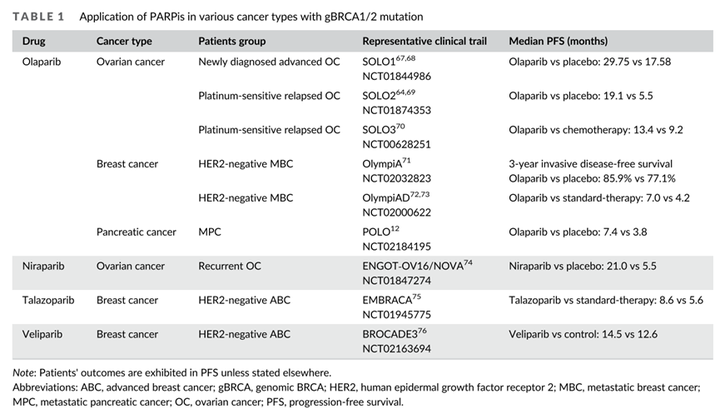
Olaparib and Talazoparib are used in BRCA mutation induced-HER2 negative breast cancer. Olaparib is also suitable for BRCA mutation induced-pancreatic cancer and HRR-deficient metastatic castration-resistant prostate cancer. Besides, curative effect of PARPi in homologous recombination deficiency(e.g. non-BRCA mutation induced-tumor) is also obvious. Combined therapy with immunotherapy, chemotherapy or radiotherapy extends clinical applications.
4. Current Situations of PARP Inhibitors
Currently, 6 PARP inhibitors have been approved worldwide, covering symptoms of various malignant tumors like ovarian cancer, breast cancer, fallopian tube cancer etc. Olaparib is the first PARP inhibitor approved by FDA. Although curative effect of these drugs in various tumor treatments are better, problems like drug resistance and adverse reaction gradually become the important challenge in clinical trial. Further investigation and optimization of treatment strategies are still required.
5. Hot Research Area
In combined therapy, PARP inhibitor(PARPi) together with immune checkpoint inhibitors(e.g. PD-1/PD-L1), chemotherapy or radiotherapy can improve anti-tumor effect. Further investigation of symptoms is exploring for potential applications of PARPi in HRD tumors(e.g. non-small cell lung cancer, glioblastoma etc). Researchers are conducting detailed studies on drug resistance mechanism, and committed to developing new PARPi to improve curative effect and treatment limitations, e.g. P-gp mediated drug efflux and recovery of HRR function.
| Recombinant Proteins | ||
| Cat.No | Product Name | Molecular Weight |
| P9758 | Recombinant Human PARP1 | 27.5 kDa |
| P2071 | Recombinant Human PARP2 | 37.5 kDa |
| P6957 | Recombinant Human PARP4 | 38.9 kDa |
| P1751 | Recombinant Human PARP9 | 44.1 kDa |
| P9943 | Recombinant Human PARP11 | 27.4 kDa |
| P5924 | Recombinant Human PARP15 | 24.5 kDa |
| Antibodies | ||
| Cat.No | Product Name | Clonality |
| FNab09939 | PARP1 antibody | monoclonal |
| FNab06151 | PARP1 antibody | polyclonal |
| FNab06152 | PARP1 antibody | polyclonal |
| FNab06156 | PARP2 antibody | polyclonal |
| FNab06157 | PARP2 antibody | polyclonal |
| FNab06158 | PARP3 antibody | polyclonal |
| FNab06160 | PARP9 antibody | polyclonal |
| FNab06153 | PARP10 antibody | polyclonal |
| FNab06154 | PARP11 antibody | polyclonal |
| FNab06155 | PARP15 antibody | polyclonal |
| ELISA Kits | ||
| Cat.No | Product Name | Sensitivity |
| EH1089 | Human PARP1 ELISA Kit | 0.375ng/ml |
| EH2530 | Human PARP2 ELISA Kit | 0.188ng/ml |
| QT-EH2530 | Human PARP2 QuickTest ELISA Kit | 0.188ng/ml |
| EH10900 | Human PARP15 ELISA Kit | 18.75pg/ml |
REFERENCES
[1]NASP modulates histone turnover to drive PARP inhibitor resistance, PMID: 40804522.
[2]FGFR3-induced Y158 PARP1 phosphorylation promotes PARP inhibitor resistance via BRG1/MRE11-mediated DNA repair in breast cancer models, PMID: 40460005.