


Abstract: T cells play an important role in adaptive immunity, anti-tumor and anti-viral reaction. After vaccination or acute infection, T cells can be differentiated into effector cells to form memory cells. During chronic infection or cancer, T cell exhaustion easily happens. Exhausted T cells are heterogeneous, some of which are stem cell-like(e.g. self-renewal and differentiation potential). These features are important for maintaining persistent anti-tumor immunity and immunotherapy. Recent researches deeply reveal regulation of exhausted T cells and stemness-related molecules, providing new T cell immunotherapy strategies via intervening with these pathways.
Keywords: Anti-tumor Immunity, T Cell Immunotherapy, T Cell Exhaustion, Tumor Microenvironment, Flow Cytometry
1. Heterogeneity of Exhausted T Cells (TEX)
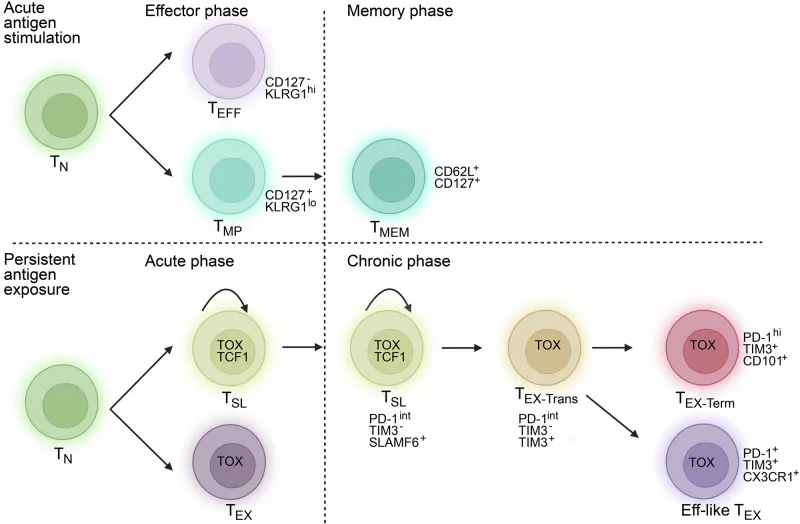
This figure shows differentiation of T cells stimulated by acute and chronic antigens. Acute antigens stimulate differentiation of naive T cells into effector T cells(TEFF, CD127hiKLRG1hi) and memory precursor cells(TMP, CD127+KLRG1lo). The latter grows into memory T cells further(TMEM, CD62L+CD127+). During persistent antigen exposure(e.g. chronic infection or tumor), T cells enter exhaustion process. Naive T cells are differentiated into early TEX and stem-like exhausted T cells(TSL, TOX+TCF1+). TSL can be self-renewed and differentiated into TEX-Trans and terminally exhausted t cells(TEX-Term, PD-1hiTim3+CD101+) or Effector-like exhausted T cells(Eff-like TEX). Stemness features of TSL are important for maintaining long-term anti-tumor immunity.
2. Flow Cytometry Markers for T Cell Subsets
T cells are highly heterogeneous under different immune conditions. The subsets can be distinguished via specific surface markers. In chronic infection or tumor microenvironment, TEX includes multiple functions: TSL/TPEX expresses TCF1, PD-1int, TIM3−, CD101−, and also co-expresses CXCR5 and Ly108(SLAMF6). Some of them also highly expresses CD62L. TEX-Trans and TEX-Term are present as CD101−TIM3+ and CD101+TIM3+CD69+ respectively. eff-like TEX highly expresses KLRG1 and CX3CR1. By contrast, TEFF and TMP in acute infection are KLRG1hiCD127lo and KLRG1loCD127hi respectively. Memory T cells include stem-cell memory T cells(TSCM, CD62L+CD45RA+CCR7+IL-7Rα+), central memory T cells(TCM, CD62L+CD45RA−), effector memory T cells(TEM, CD62L−CD45RA−), TEMRA(CD62L−CD45RA+) and tissue-resident memory T cells(TRM, CD69+CD103+). These marker combinations provide key evidences for analysis of T cell fate and optimization of immunotherapy.
3. Key Regulation Role of TCF1
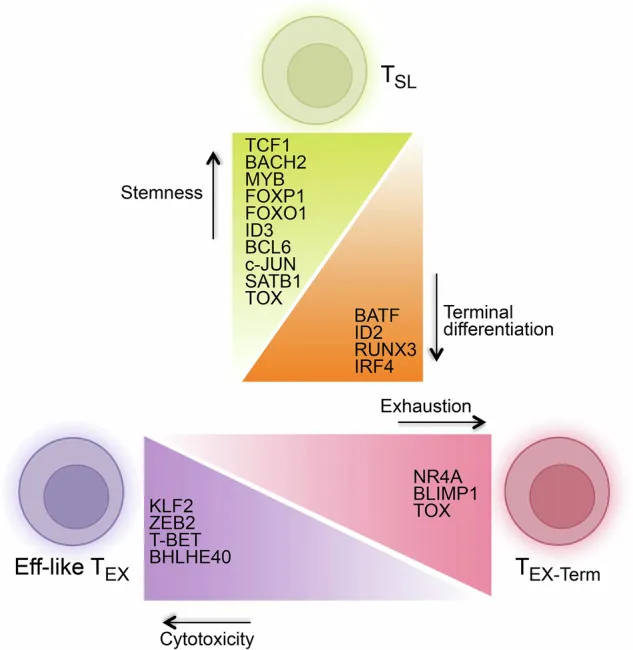
TCF1 is the key transcription factor for regulating stemness and differentiation of T cells, including two subsets: p33 and p45. Roles in T cell development, memory formation and exhaustion process are significant. TCF1 establishes T-cell identity and maintains stemness via remodeling chromatin structure and histone acetylation. In acute infection, TCF1(especially for p45) restricts excessive effect differentiation, and promotes generation of memory T cells. Regulation of pathways(e.g. EOMES, BCL-2) maintains secondary immune response. In chronic infection or tumor microenvironment, TSL expresses CXCR5 and Ly108, excluding terminal markers(e.g. TIM3/CD39). Self-renewal capability is sensitive for PD-1 immune checkpoint inhibitor therapy. Researches show TCF1 inhibits premature terminal differentiation and also maintains TSL cell fate via pathways(e.g. Wnt/β-catenin). Roles in coupling of T cell stemness, memory formation and anti-tumor immune response are significant.
4. Effects of T cell Exhaustion on Tumor Immune Microenvironment
T cell exhaustion obviously reduces anti-tumor immunity, and remodels immunosuppressive tumor microenvironment(TME). Exhausted T cells show decrease of effector function, secretion of cytokines(e.g. IFN-γ, TNF-α, IL-2), and cytotoxicity. Persistently high expression of inhibitory receptors(e.g. PD-1, TIM-3, LAG-3) inhibits self-function. Ligand-activated MDSCs and regulatory T cells aggravate immunosuppression. Besides, damaged mitochondrial function and poor metabolic adaptation are disadvantageous in nutrient-deficient TME. Insufficient amount or differentiation blockade of TCF1+ TSL cells can't continuously supplement effector T cells. Rapid exhaustion of immune response promotes phenotypic formation of cold tumor. Thus, improvement of immunotherapy effects depends on restoration of T cell stemness or reinvigoration of exhaustion.
5. T Cell Exhaustion Markers in Flow Cytometry
Multicolor flow cytometry panel design accurately analyzes T cell status according to surface and functional markers: Classical exhaustion phenotypes include CD8⁺PD-1⁺TIM3⁺LAG-3⁺TIGIT⁺. Stemness-exhaustion hierarchy depends on comparison among TCF1⁺TOX⁺PD-1int(stem-like) and TCF1⁻TOX⁺TIM3⁺(terminal exhaustion). Addition of CXCR6 localizes T cells near dendritic cells in tumor microenvironment. Intracellular staining is very important for detecting transcription factors(e.g. TCF1, TOX, EOMES, T-BET) and phosphorylated signal proteins(p-STAT5/3). Besides, flow cytometry can simultaneously evaluate proliferation(Ki-67/CFSE), cytokine secretion(e.g. decreased IFN-γ, TNF-α, IL-2) and mitochondrial function(MitoTracker), comprehensively reflecting dysfunction of exhausted T cells.
| Recommended Products | |||
| Species | Cell Populations | Flow Cytometry Antibody Combination | Cat.No |
| Human | T/B/NK cell populations detection | CD45-PerCP | PCP-30039 |
| CD3-FITC | FITC-30004 | ||
| CD16-PE | PE-30061 | ||
| CD56-PE | PE-30008 | ||
| CD19-APC | APC-30066 | ||
| Human | Thl/Th2 cell populations detection | CD3-PerCP/Cyanine5.5 | PCP55-30004 |
| CD4-FITC | FITC-30005 | ||
| IFN-γ-PE | PE-30053 | ||
| IL4-APC | APC-30043 | ||
| Mouse | Thl/Th2 cell populations detection | CD3-PerCP/Cyanine5.5 | PCP55-30002 |
| CD4-FITC | FITC-30128 | ||
| IFN-γ-PE | PE-30074 | ||
| IL4-APC | APC-30026 | ||
| Human | Treg cell populations detection | CD4-FITC | FITC-30005 |
| CD25-PE | PE-30035 | ||
| CD3-PerCP-Cy5.5 | PCP55-30004 | ||
| CD127-FineTest®647 | F647-30033 | ||
| Mouse | Treg cell populations detection | CD4-FITC | FITC-30128 |
| CD25-APC | APC-30017 | ||
| FOXP3-PE | PE-30111 | ||
REFERENCES
[1]Macrophage-targeted immunocytokine leverages myeloid, T, and NK cell synergy for cancer immunotherapy, PMID: 41265436.
[2]Chronic antigen stimulation in melanoma induces T cell exhaustion and limits efficacy of T cell bispecific therapies, PMID: 40891421.