


Abstract: BMPs(bone morphogenetic proteins) family contains several subtypes, widely involved in developmental regulation of various organs and tissues. Roles in osteoblastic differentiation are important. BMP-2 is one of BMP proteins with the strongest osteogenic potential, promoting directional differentiation and proliferation of undifferentiated MSCs(mesenchymal stem cells) to chondroblast and osteoblast. Involvement in development, homeostasis maintenance and injury reconstruction of bone and cartilage obviously improve repair efficiency of bone defect. BMP-2 signaling pathway is the complex and precise process.
Keywords: BMP-2 Signaling Pathway, Bone Regeneration, Bone Tissue Engineering, Osteogenesis, Osteoblastic Differentiation
1. BMP-2 Signaling Pathway
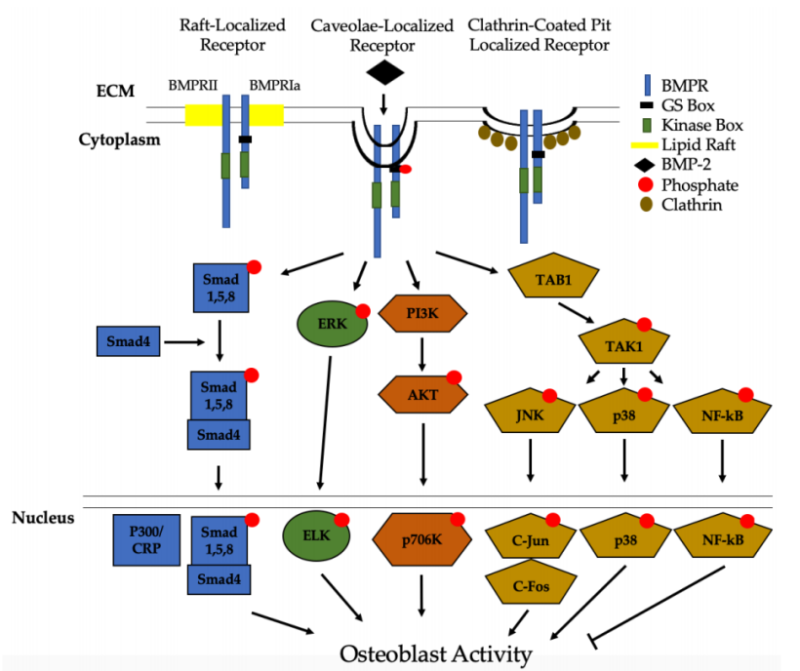
Smad signaling pathway is the classical BMP-2 pathway.
1.1. Binding between Ligands with Receptors
BMP is secreted out of cells, and forms the complex via binding with type I and type II serine/threonine kinase receptors.
1.2. Activation of Smad Signaling Pathway
Activated receptor complex phosphorylates R-Smad proteins(e.g. Smad1/5/8). Phosphorylated R-Smad binds with Smad4 and forms the complex to enter nucleus.
1.3. Gene Transcription and Regulation
In nucleus, other transcription factors help Smad complex bind with promoter region of specific gene, promoting or inhibiting the transcription of target gene. Key osteoblastic-related genes(e.g. Runx2, Osterix) are activated to control differentiation of osteoblasts.
Besides, BMP can also activate non-Smad pathway to coordinate the final fate of cells, e.g. MAPK pathway, PI3K/Akt pathway.
2. Significance of Recombinant BMP-2
BMP-2 can be separated from bone, but the yield is extremely lower. Per kilogram of cortical bone only contains 1.0-2.0μg active proteins. Restrictions like potential pathogenic contamination, complex purification process and deficiency of donor materials seriously prevent clinical applications. Rapid development of recombinant DNA technology and molecular biology promotes manual synthesis of recombinant BMP protein, providing new therapy for bone defect repair. Recombinant BMP-2 is featured with earlier induction of osteogenesis, higher bone mass than natural BMP-2, better biological activity and biocompatibility. Potential applications in bone tissue engineering and bone repair are great.
3. Key Clinical Applications
Recombinant human BMP-2(rhBMP-2) was approved by FDA, following applications in lumbar interbody fusion in 2002, open fracture of tibia in 2004 and bone regeneration in oral and maxillofacial region in 2007. Recombinant human BMP-2 is used in clinical treatment and produced via genetic engineering. Usually, binding with a carrier(type I collagen sponge derived from bovine achilles tendon) is required. The carrier takes effects locally over time as the sustained-release system, providing three-dimension scaffold for cell migration and bone ingrowth.
3.1. Spinal Fusion
Situations: Treatment for intervertebral disc degeneration, spondylolisthesis, spinal instability etc.
Effects: Instead of traditional autologous iliac bone grafting, implant BMP-2 and the carrier(e.g. collagen sponge) into intervertebral or posterolateral area, promoting bone bridge formation and fusion. This is the most classical and widest application.
3.2. Open Fracture of Tibia
Situations: Treatment for acute open fracture of tibia with bone defect, but soft tissue coverage is better.
Effects: After debridement and internal fixation, implant BMP-2 into fracture and defect sites to stimulate osteogenesis and healing, and reduce reoperation rate.
3.3. Nonunion/Bone Defect
Situations: impossible bone healing after fracture(nonunion); trauma or tumor resection induced massive bone defect.
Effects: alternative material for bone transplant, filling in defect area via inducing new bone formation.
3.4. Oral and Maxillofacial Surgery
Situations: Elevated alveolar ridge, bone repair after removal of jaw cysts, maxillary sinus lifting etc
Effects: Before dental implant, reconstruct sufficient bone structure for patients with alveolar bone deficiency.
4. Advantages and Challenges
4.1. Advantages
Strong osteogenic potential: obvious effects can promote bone healing.
Avoid complications in bone graft donor site: autogenous bone graft requires bone harvesting from patients' body, resulting in complications like bone pain, infection and nerve injury etc. BMP-2 avoids these problems.
Sufficient supply: not restricted by autologous bone mass, applied in massive bone defect.
Decreased operative time and bleeding: bone harvesting process is not required.
4.2. Challenges and Risks
Applications of BMP-2 are imperfect. Controversies and risks also exist, e.g. dose-dependent side effects.
Postoperative inflammation and edema: Especially in anterior cervical surgery, suppression of trachea and esophagus induced by severe edema of local soft tissue can result in complications like dyspnea, dysphagia etc. This is the main reason for strict restriction in cervical vertebra.
Heterotopic Ossification: Formation of new bone in non-target area may suppress nerve or affect joint function.
Bone resorption/osteolysis: In the early implant phase, BMP-2 activates osteoclast and possibly results in bone resorption. Improper control can affect stability.
Immune Response: Body of some patients may produce antibodies.
Carrier Problem: Perfect carriers are still in development. Release kinetics and space maintenance ability of current carrier requires for optimization.
Carcinogenicity controversy: Some researches show high dose of BMP may be related to tumorigenesis. Currently, this is inconclusive and requires for long-term deeper investigation.
5. Future Research
To maximize curative effect of BMP-2 and minimize the risk, scientists are investigating:
New delivery system: develop more intelligent carriers(e.g. hydrogel, nanomaterial, 3D printed scaffold) to accurately control dose and release rate of BMP-2.
Low dose/synergism: Explore for lower dose of BMP-2. Using with other growth factors or drugs can produce synergism and decrease side effect.
Gene therapy: Import gene encoding BMP-2 into the target cell via viral or non-viral carriers. Then, cells produce BMP-2 continuously and locally to achieve long-term and stable bone regeneration.
Biomimetic peptide: Development is only involved in shorter peptide fragment of BMP-2 core functional area. The cost and immunogenicity are lower.
6. Conclusion and Prospect
BMP-2 is a revolutionary bone regeneration inducible factor. Roles in complex orthopedic issues(especially for spinal fusion and massive bone defect) are very important. Thus, BMP-2 becomes the alternative solution of autogenous bone graft. Deeper investigation of BMP and related technologies can provide safer and more cost-effective therapy for bone injury patients.
| Cat.No | Product Name | Species | Host |
| Pr22488 | Recombinant Human/Mouse/Rat BMP-2 | Human/Mouse/Rat | E.Coli |
REFERENCES
[1]BMP-2 generates a functional bone marrow niche by inducing the differentiation of local mesenchymal cells into CAR cells, PMID: 40080674.
[2]An Injectable BMP-2-Releasing Porous Hydrogel Regulating the Paracrine Effects of ADSCs Promotes Tendon-to-Bone Healing in Rotator Cuff Repair, PMID: 40549875.