


Abstract: Fc receptor(FcR) is the cell surface protein specifically binding with Fc fragment of antibodies. Different immunocytes express different types of FcR to recognize relevant antibodies. In flow cytometry, IgG monoclonal antibodies are commonly used for staining, and mainly bind with Fcγ receptor(FcγR). According to affinity differences in IgG Fc fragment, FcγR contains three subgroups: high affinity FcγRI(CD64), low affinity FcγRII(CD32) and FcγRIII(CD16). These receptors are widely expressed in monocytes, macrophages, dendritic cells, NK cells and some T cells. Unblocking leads to non-specific antibody binding and interferes with detection result during flow cytometry. Thus, Fc blocker usually improves staining specificity.
Keywords: Fc Receptor, Fc Blocker, Fc Blocking Flow Cytometry, Staining Specificity
1. Expression of Fcγ Receptor
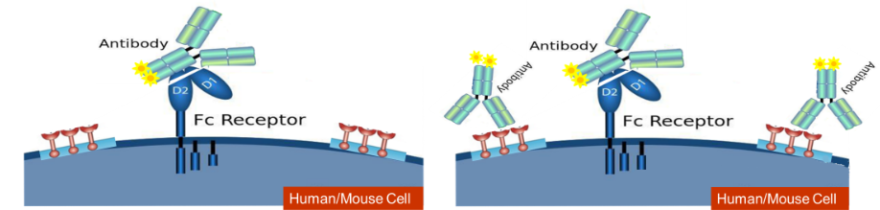
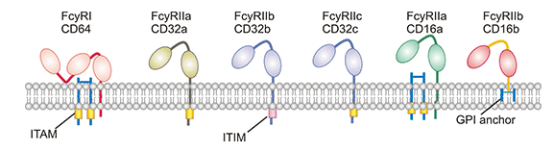
Fcγ receptor is widely expressed on the surface of various immunocytes. Subtype distribution in cells are specific: FcγRI(CD64) is usually found in monocytes, macrophages, dendritic cells(DC), activated neutrophils and eosinophils; FcγRII includes FcγRIIa(expressed in neutrophils, monocytes and DC), FcγRIIb(distributed in B cells and myeloid cells) and FcγRIIc(distributed in monocytes/macrophages, neutrophils, and NK cells); FcγRIII includes FcγRIIIa(medium affinity, widely expressed in various white blood cells) and FcγRIIIb(low affinity, limited to neutrophils). In flow cytometry staining, high expression of FcγR in target cells enables the possible non-specific binding with Fc fragment of IgG antibody, resulting in increased background and even false positive signal. Thus, Fc blocker(e.g. anti- CD16/32 antibody) usually blocks Fc receptor before the experiment, ensuring specific staining and reliable data.
2. Types of Fc Receptor
According to bound immunoglobulin, Fc receptor(FcR) can be divided into five types: FcγR(IgG), FcεR(IgE), FcαR(IgA), FcμR(IgM) and FcδR(IgD). IgG monoclonal antibody binds with FcγR. Based on different affinity to IgG Fc fragment, FcγR is divided into three subgroups: high affinity FcγRI(CD64) > medium affinity FcγRIII(CD16) > low affinity FcγRII(CD32). Affinity differences directly affect non-specific antibody binding with cells expressing FcγR, and should be primarily considered in flow cytometry staining.
3. Effects on Flow Cytometry
Fc receptor(FcR) obviously affects experimental accuracy during flow cytometry, including:
Non-specific binding: Fc fragment of IgG flow cytometry antibody can bind with FcγR on the cell surface(e.g. CD16, CD32, CD64), resulting in adhesion of antibody on non-target cell and false positive signal.
Increased background: In cells highly expressing FcR(e.g. monocytes, macrophages, dendritic cells, NK cells, activated neutrophils), unblocking FcR obviously increases staining background and decreases signal-to-noise ratio.
Masking of weak positive signal: Non-specific binding may mask real signal of lowly expressed antigen, affecting accurate recognition of rare or weakly positive cell populations(e.g. some T cell subpopulations).
Interference of multicolor panel: In high-dimensional flow cytometry analysis, FcR mediated non-specific staining may leak to multiple detection channels, interfering with compensation and gating setting.
Variations among batches or samples: Expression level of FcR in different samples changes(e.g. inflammation). Unblocking decreases experimental reproducibility.
Thus, blocking Fc receptor with Fc blocker(e.g. anti- CD16/32 antibody) before staining plays an important role in maintaining specificity, sensitivity and reproducibility of flow cytometry data.
| Recommended Products | |||
| Species | Cell Populations | Flow Cytometry Antibody Combination | Cat.No |
| Human | T/B/NK cell populations detection | CD45-PerCP | PCP-30039 |
| CD3-FITC | FITC-30004 | ||
| CD16-PE | PE-30061 | ||
| CD56-PE | PE-30008 | ||
| CD19-APC | APC-30066 | ||
| Human | Thl/Th2 cell populations detection | CD3-PerCP/Cyanine5.5 | PCP55-30004 |
| CD4-FITC | FITC-30005 | ||
| IFN-γ-PE | PE-30053 | ||
| IL4-APC | APC-30043 | ||
| Mouse | Thl/Th2 cell populations detection | CD3-PerCP/Cyanine5.5 | PCP55-30002 |
| CD4-FITC | FITC-30128 | ||
| IFN-γ-PE | PE-30074 | ||
| IL4-APC | APC-30026 | ||
| Human | Treg cell populations detection | CD4-FITC | FITC-30005 |
| CD25-PE | PE-30035 | ||
| CD3-PerCP-Cy5.5 | PCP55-30004 | ||
| CD127-FineTest®647 | F647-30033 | ||
| Mouse | Treg cell populations detection | CD4-FITC | FITC-30128 |
| CD25-APC | APC-30017 | ||
| FOXP3-PE | PE-30111 | ||
REFERENCES
[1]Optimization of the Blocking and Signal Preservation Protocol in High-Parameter Flow Cytometry, PMID: 40996492.
[2]Nipocalimab, an immunoselective FcRn blocker that lowers IgG and has unique molecular properties, PMID: 39936406.