


Abstract: In flow cytometry, Clone ID is the unique identifier of monoclonal antibody, and derived from single B cell cloning for antibody production against specific determinant. Each Clone ID represents an independent cloning system. Identification of the same antigen by different Clone IDs shows differences in epitope, affinity and response spectrum. Clone ID ensures specificity of antibodies and reproducible experiment. Applications of different Clone IDs may be also varied, including paraffin and frozen section. Experimental compatibility should be considered during selection.
Keywords: Clone ID Selection, Flow Cytometry Antibodies, Specificity and Affinity, Flow Cytometry Analysis
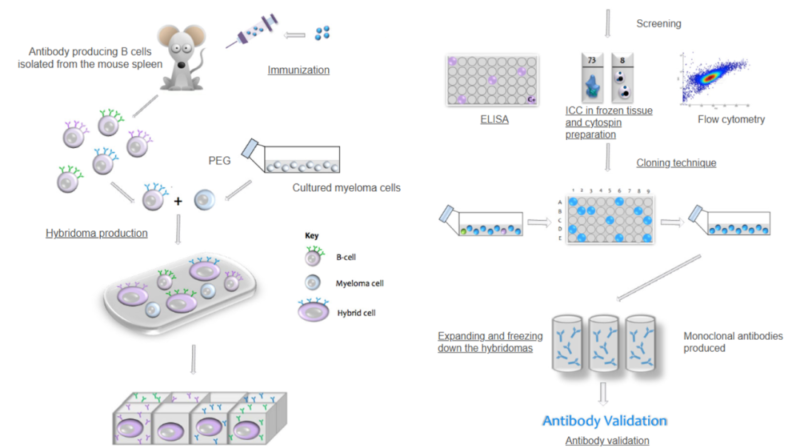
1. Significance of Clone ID
Clone ID facilitates experimental design, tracking and result management. Roles of Clone ID in functional experiments are very important. Different cloning may have specific functions like activation or blocking, e.g. RMP1-14 can prevent PD-1/PD-L1 pathway from activating immune cells. However, RMP1-30 fails to do so. During protein expression detection, effects of different cloning for the same target are similar. But, performance may be varied due to affinity, specificity or different epitopes. E.g. Protein binding induced-epitope masking and antibody binding affected by fixation/antigen retrieval can weaken cloning signal. Thus, Clone ID should be carefully selected according to experimental type.
2. Important Factors in Clone ID Selection
2.1. Differences between Specificity and Affinity
Antibodies with different Clone IDs can identify the same antigen. But targeting different antigenic epitopes results in obviously different specificity and affinity. Lower specificity of some cloning may be induced by cross-reaction. Specificity of other cloning is higher. Cloning with higher affinity can produce strong signal in lowly expressed antigen samples, improving detection sensitivity.
2.2. Effects of Conjugated Fluorescein
Although many cloning has been widely validated, showing stable function. But the performance may be effected by conjugation type of fluorescein. Conjugation between the same cloning with different fluoresceins may change signal intensity and background, affecting distinction between positive and negative groups. Besides, conjugation technology from different vendors may result in different non-specific binding level.
2.3. Different Applications and Functions
Usages and functional activity of different cloning are varied. E.g. anti-CD3 HIT3a may be suitable for soluble stimulation. UCHT1 requires for coating. Functionally, CB16 anti CD16 clone obviously improves activation and expansion of NK cell. MEM-154 is almost inactive, showing clone ID selection directly affects experimental results.
2.4. Compatibility with Fixation/Permeabilization Buffer Kit
Fixation/permeabilization buffer kit may affect identification of protein epitope via antibodies, resulting in change in staining effects. Performance of antibodies with different Clone IDs is varied after fixation and permeabilization. Some cloning can still effectively bind. Signal of others is weakened or lost. Thus, selection of compatible fixation/permeabilization solution depends on Clone ID.
3. Clone ID for FCM Antibodies
Important roles of Clone IDs in flow cytometry can ensure experimental specificity and reproducibility. Many factors should be considered during selecting Clone ID of FCM antibodies. First, confirm whether the Clone ID is validated for flow cytometry. Second, focus on whether the epitope can be still identified after fixation and permeabilization, especially during intracellular staining. Affinity and specificity of different Clone IDs are varied. Lower background and strong positive signal are recommended. Besides, applications of Clone IDs in citations/database/similar experiments, and conjugation compatibility with fluoresceins should be considered. Finally, focus on functional differences of Clone IDs and follow experimental purpose. E.g. some Clone IDs are just suitable for stimulation or blocking experiment.
| Recommended Products | |||
| Species | Cell Populations | Flow Cytometry Antibody Combination | Cat.No |
| Human | T/B/NK cell populations detection | CD45-PerCP | PCP-30039 |
| CD3-FITC | FITC-30004 | ||
| CD16-PE | PE-30061 | ||
| CD56-PE | PE-30008 | ||
| CD19-APC | APC-30066 | ||
| Human | Thl/Th2 cell populations detection | CD3-PerCP/Cyanine5.5 | PCP55-30004 |
| CD4-FITC | FITC-30005 | ||
| IFN-γ-PE | PE-30053 | ||
| IL4-APC | APC-30043 | ||
| Mouse | Thl/Th2 cell populations detection | CD3-PerCP/Cyanine5.5 | PCP55-30002 |
| CD4-FITC | FITC-30128 | ||
| IFN-γ-PE | PE-30074 | ||
| IL4-APC | APC-30026 | ||
| Human | Treg cell populations detection | CD4-FITC | FITC-30005 |
| CD25-PE | PE-30035 | ||
| CD3-PerCP-Cy5.5 | PCP55-30004 | ||
| CD127-FineTest®647 | F647-30033 | ||
| Mouse | Treg cell populations detection | CD4-FITC | FITC-30128 |
| CD25-APC | APC-30017 | ||
| FOXP3-PE | PE-30111 | ||
REFERENCES
[1]Development of an anti-CDH15/M-cadherin monoclonal antibody Ca15Mab-1 for flow cytometry, immunoblotting, and immunohistochemistry, PMID: 40688506.
[2]Epitope analysis of an anti-mouse CCR1 monoclonal antibody S15040E using flow cytometry, PMID: 41542175.