


Abstract: Roles of rare cells(e.g. circulating tumor cells, tumor stem cells, antigen specific T cells, iNKT cell and fetal cells in maternal blood etc) in disease diagnosis and staging, monitoring of minimal residual disease, and immune response are important(especially for immunological memory of SARS-CoV-2 and latent infection of HIV). Rare cell analysis requires for high sensitive technology and collection of numerous events to determine signal-to-noise. Comprehensive workflow optimization plays an important role in accurate recognition of these rare events, including sample collection, strict control and analysis via advanced hardware and software etc. Applications in basic research, translational medicine, and clinical diagnosis are further promoted.
Keywords: Rare cell analysis, Flow cytometry, Rare event detection, Multi-color panel design, Data management
1. Systematic Optimization of Rare Cell Assays
Rare cell research should systematically optimize the assay process, covering sample collection, pre-treatment, assay design, data collection etc. Low frequency of rare events(≤0.01%) should collect sufficient events to maintain high signal-to-noise and ensure reliable detection. Besides, negative and positive controls, proper selection and calibration of hardware and analytical software are very important for improving detection sensitivity and reliable results.
2. Sample Volume Estimation and Multi-color Panel Design
In rare cell research, accurate calculation of biological sample quantity depends on estimated frequency. E.g. Low volume(ml) requires for complete use of cerebrospinal fluid(CSF); Blood sample should be more accurately estimated. E.g. Functional analysis of iNKT cells in HIV infectors should synchronously detect CD3, CD4, CD8, invariant TCR, viability markers and various intracellular cytokines(e.g. TNF-α, IFN-γ, IL-4, IL-17). A minimum of nine colors are required for labeling. Decrease of CD3⁺ T cells in untreated HIV patients may collect 50 mL whole blood to obtain sufficient events in Poisson statistics (especially for analysis of resting or stimulated cells).
3. Optimizing Enrichment and Multi-color Labeling for Rare Cell Detection
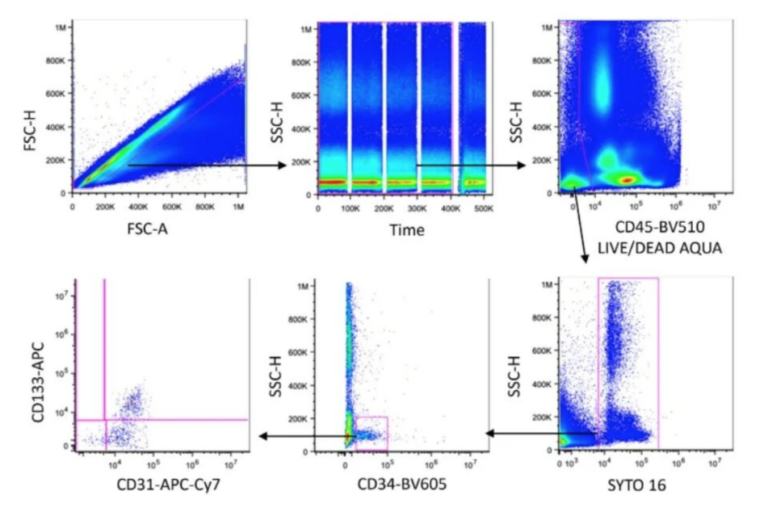
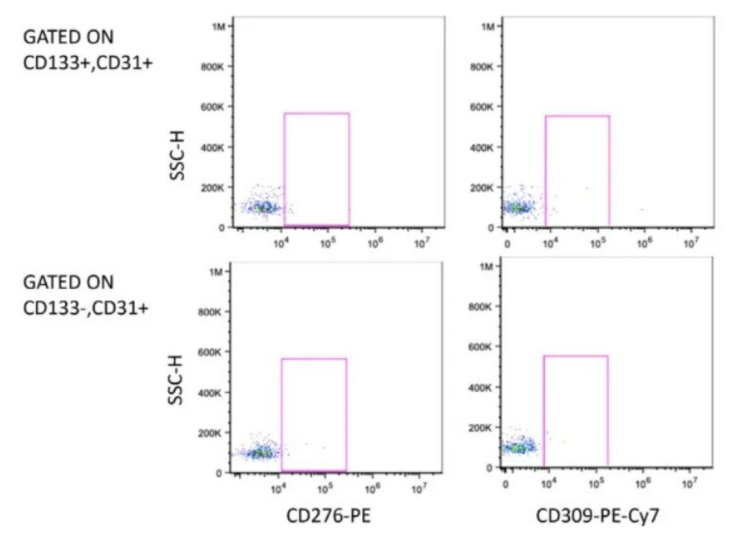
In rare cell research, enrichment and proper selection of labeling depends on experimental purpose(e.g. phenotypic identification or functional analysis). E.g. for circulating endothelial cells(CEC) and endothelial progenitor cells(EPC), deficiency of generally approved labeling and standardized enrichment method arouses controversy in quantification. Enrichment can decrease background interference but may cause loss of target cells. Labeling selection depends on fluorescent channel quantity of flow cytometer and collection speed. Keep key identification markers first, e.g. Vα24Jα18 TCR of iNKT cell. During multi-color combination, false positive can be decreased via matching the brightest fluorescent dye with the weakly expressed antigen. FMO control and accurate compensation can help to ensure reliable results.
4. Poisson Statistics and Control-based Validation for Rare Event Detection
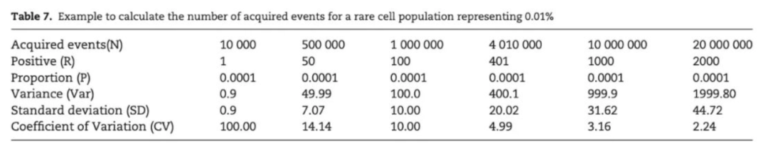
Poisson statistics determine required events quantity to ensure reliable detection for rare positive events. CV should be lower than 5%. E.g. for 10% positive rate, collection of 5,000 events satisfies CV≈4.24%. However, for low-frequency events(e.g. <0.1%), multi-color analysis still hardly satisfies ideal statistical requirements. After removal of non-specific signal and setting strict controls(e.g. FMO), true positive is still determined from number of positive cells lower than traditionally statistical cutoff, even if sample signal is obviously higher than control. Reasonable experimental design and control setting are important in analysis of rare events.
5. Cutoff Optimization and Contamination Control in Flow Cytometry
In flow cytometry, proper setting of cutoff is important for distinguishing real signal from background noise, aiming to maximize signal-to-noise ratio. Remove dead cells, debris, dimers and aggregates via viability dye and morphological parameters(e.g. FSC/SSC). Recommend to label irrelevant cells with "DUMP" channel to decrease interference. Scatter diagram with time and target parameter can recognize and remove instrumental clogging induced transient abnormal events. Besides, clean flow cytometry and complete washing among samples can avoid cross-contamination and false positives, improving accuracy and reliability of data.
6. Computational and Data Management for Efficient Flow Cytometry Analysis
Data analysis in flow cytometry requires for a computer with over 8 GB RAM. Data files are very large when collecting a large number of events(e.g. 10 million) and multi-parameters(e.g. 10 colors fluorescence and 2 scattering parameters). Decrease of file size can cancel records of optional parameters. Setting of fluorescence or scatter cutoff and less collection of irrelevant events(e.g. debris) can improve analytical efficiency and system performance.
| Recommended Products | |||
| Species | Cell Populations | Flow Cytometry Antibody Combination | Cat.No |
| Human | T/B/NK cell populations detection | CD45-PerCP | PCP-30039 |
| CD3-FITC | FITC-30004 | ||
| CD16-PE | PE-30061 | ||
| CD56-PE | PE-30008 | ||
| CD19-APC | APC-30066 | ||
| Human | Thl/Th2 cell populations detection | CD3-PerCP/Cyanine5.5 | PCP55-30004 |
| CD4-FITC | FITC-30005 | ||
| IFN-γ-PE | PE-30053 | ||
| IL4-APC | APC-30043 | ||
| Mouse | Thl/Th2 cell populations detection | CD3-PerCP/Cyanine5.5 | PCP55-30002 |
| CD4-FITC | FITC-30128 | ||
| IFN-γ-PE | PE-30074 | ||
| IL4-APC | APC-30026 | ||
| Human | Treg cell populations detection | CD4-FITC | FITC-30005 |
| CD25-PE | PE-30035 | ||
| CD3-PerCP-Cy5.5 | PCP55-30004 | ||
| CD127-FineTest®647 | F647-30033 | ||
| Mouse | Treg cell populations detection | CD4-FITC | FITC-30128 |
| CD25-APC | APC-30017 | ||
| FOXP3-PE | PE-30111 | ||
REFERENCES
[1]Microfluidic rare cell analysis beyond counting: workflow design from enrichment to multi-omics, PMID: 42389994.
[2]Machine Learning-Enhanced Microfluidic Impedance Platform for Rare Cell Analysis, PMID: 41785333.