


Abstract: Lymphocytes play an important role in immune response, including T, B and NK cell. The typing depends on source, morphology, surface/intracellular markers and functional differences. The proportion of T/B/NK cell subpopulation in lymphocytes or absolute quantity change from lymphocyte subset test reflects body's immune status. Wide clinical applications include HIV infection, hematological cancers, immune assessment of various cancers, and auxiliary diagnosis for autoimmune diseases(e.g. rheumatoid arthritis), allergic diseases(e.g. asthma) and acute and chronic infections. Besides, analysis of lymphocyte subpopulation also contributes to health management and alert for early disease risk.
Keywords: Lymphocyte Subset Test, TBNK Flow Cytometry, TBNK Assay, Immune Response
1. Types of Lymphocytes
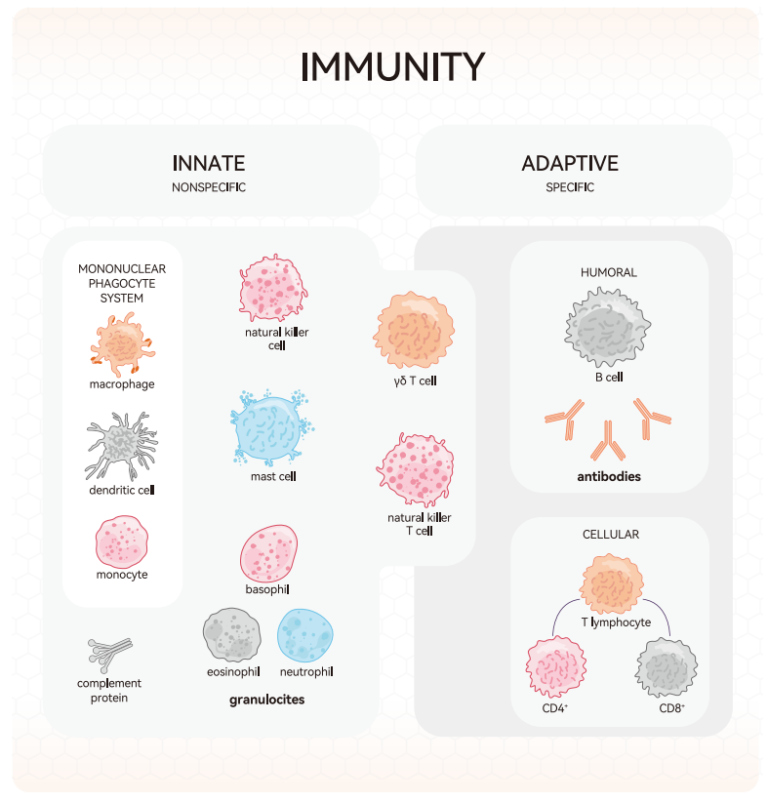
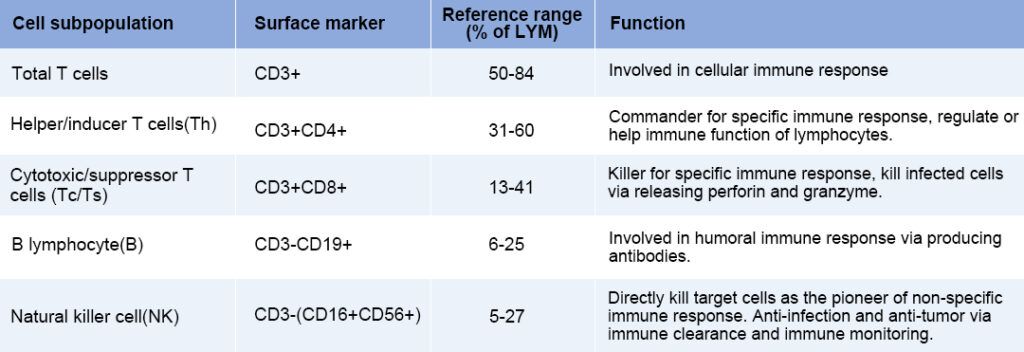
Lymphocytes are important cell populations in immune system. Expression differences of surface differentiation antigen distinguish subpopulations: T cell(CD3⁺, about 65%-75%), B cell(CD3⁻CD19⁺, about 8%-15%) and NK cell(CD3⁻CD16⁺CD56⁺, about 5%-10%). T cells can be divided into helper T cells(e.g. CD3⁺CD4⁺) and cytotoxic T cells(e.g. CD3⁺CD8⁺) according to expression of CD4 and CD8. Their roles in immune regulation and target cell killing are important. Proportion and quantity of these subpopulations are important indicators for evaluating body's immune status.
2. Lymphocyte Subset Test
Lymphatic subpopulations are detected via flow cytometry(FCM). Fluorescence-labeled specific antibodies recognize superficial or intracellular differentiation antigens(CD molecules) of peripheral blood lymphocytes. Accurate identification and quantification for T/B/NK cells are realized. Each subpopulation has characteristic surface marker and affords specific immune function.
3. Four-color Flow Cytometry
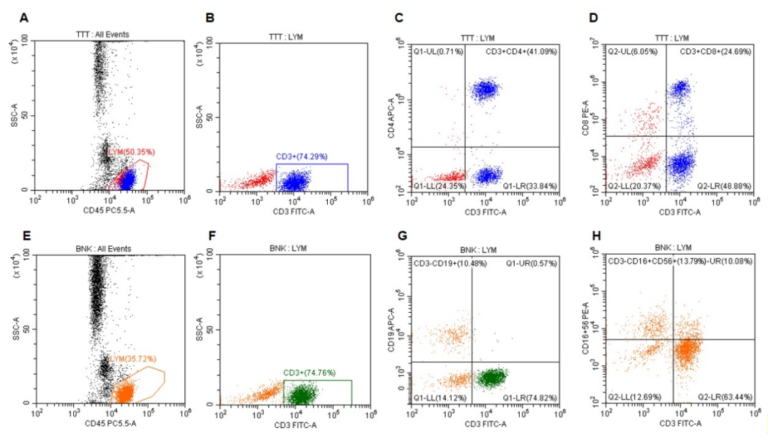
Flow cytometry for lymphatic subpopulations usually utilizes double tube solution:
A tube(CD45/CD3/CD4/CD8): analyze T cell subpopulations;
B tube(CD45/CD3/CD19/CD16+CD56): identify B and NK cell
During data analysis, select total lymphocyte population via CD45/SSC diagram. Then, gating of CD3⁺ cell determines T cell. Obtain proportion of helper T cells(e.g. CD3⁺CD4⁺) and cytotoxic T cells(e.g. CD3⁺CD8⁺) via CD3/CD4 and CD3/CD8 scatter diagram respectively. Rare CD4+CD8+ double-positive (DP) T cells or CD4-CD8- double-negative (DN) T cells can be clearly recognized via CD4/CD8 scatter diagram. B cells(e.g. CD3⁻CD19⁺) and NK cells(CD3⁻CD16⁺CD56⁺) are quantified via CD3/CD19 and CD3/CD16+56 scatter diagram respectively.
Some special phenotypes should be greatly focused: weak expression of CD19 in a few NK cells may interfere with minimal residual detection for B-ALL. It's suggested to remove together with NK labeling. Some NK cells can weakly express CD8 instead of CD4; Cells expressing both CD3 and CD16/CD56 are NKT cells(shown in figure below). Understanding of these atypical subpopulation can avoid misjudgments and improve accuracy of result analysis.
4. Significance of TBNK Flow Cytometry
In normal conditions, quantity and proportion of TBNK lymphocyte subpopulation are relatively stable, synergistically maintaining body's immune homeostasis. TBNK assay can objectively evaluate current immune status of individuals. Abnormal proportion or absolute value of each subpopulation usually indicates immune imbalance, possibly related to various diseases, e.g. infection, autoimmune diseases, tumors, immunodeficiency etc. Thus, the detection is the important clinical immunological assessment tool, contributing to auxiliary diagnosis, analysis of pathogenesis, therapeutic efficacy monitoring and prognosis prediction etc.
| Recommended Products | |||
| Species | Cell Populations | Flow Cytometry Antibody Combination | Cat.No |
| Human | T/B/NK cell populations detection | CD45-PerCP | PCP-30039 |
| CD3-FITC | FITC-30004 | ||
| CD16-PE | PE-30061 | ||
| CD56-PE | PE-30008 | ||
| CD19-APC | APC-30066 | ||
| Human | Thl/Th2 cell populations detection | CD3-PerCP/Cyanine5.5 | PCP55-30004 |
| CD4-FITC | FITC-30005 | ||
| IFN-γ-PE | PE-30053 | ||
| IL4-APC | APC-30043 | ||
| Mouse | Thl/Th2 cell populations detection | CD3-PerCP/Cyanine5.5 | PCP55-30002 |
| CD4-FITC | FITC-30128 | ||
| IFN-γ-PE | PE-30074 | ||
| IL4-APC | APC-30026 | ||
| Human | Treg cell populations detection | CD4-FITC | FITC-30005 |
| CD25-PE | PE-30035 | ||
| CD3-PerCP-Cy5.5 | PCP55-30004 | ||
| CD127-FineTest®647 | F647-30033 | ||
| Mouse | Treg cell populations detection | CD4-FITC | FITC-30128 |
| CD25-APC | APC-30017 | ||
| FOXP3-PE | PE-30111 | ||
REFERENCES
[1]Automated analysis of flow cytometry data with minimal training files: Research evaluation of an elastic image registration algorithm for TBNK, stem cell enumeration, and lymphoid screening tube assays, PMID: 39417216.
[2]Validation of an Optimized DuraClone Phenotyping Kit Workflow for TBNK Subset Quantification, PMID: 41063580.