


Abstract: Principle of Fc block can help to understand when to add Fc blocker during flow cytometry. Antibodies consist of Fab and Fc fragment. The Fab fragment specifically binds with antigens. Except T cells, all leukocytes express Fc receptors(e.g. CD16, CD32, CD64 etc). These receptors specifically bind with Fc fragment, leading to deviated results. Fc block can avoid the situation before antibody incubation. Blocking of these Fc receptors in advance removes non-specific binding. Accurate experimental results reflect the situation of target antigen. The reliability of experimental data can be effectively improved.
Keywords: Fc Block, Flow Cytometry, Non-specific Antibody Binding, Fc Receptors, Isotype Control
1. Roles of Fc Receptors
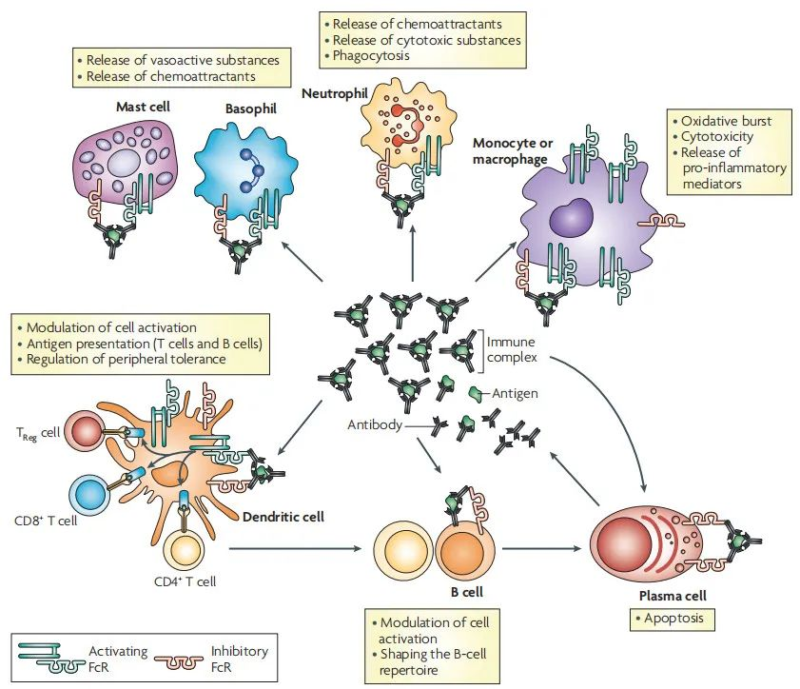
Fc receptors are found on the surface of various immune cells, e.g. monocytes, macrophages, DC cells, eosinophils, basophils, neutrophils, myeloid cells, B cells and NK cells etc. Their roles in immune response are very important. Phagocytosis helps macrophages and neutrophils recognize and remove antibody-coated microorganism. Promoted lysosome degrades pathogens. NK cells attack labeled cells via Fc receptors mediated-cytotoxicity. Activated immune cells secrete cytokines and chemokines. Regulation of immune response can attract other immune cells to infected or inflammatory regions. These functions maintain body’s health.
2. How to Block
Fc blockers in the market(e.g. Fc block™ Reagent, TruStain FcX™ and Fc Receptor Binding Inhibitor etc) prevent non-specific binding of Fc fragment via blocking the epitope of receptors, e.g. CD16(FcγR III), CD32(FcγR II) and CD64(FcγR I). These reagents usually mention targets and suggestions in the product manual. Experimenters can choose proper reagents according to their requirements and improve accuracy of flow cytometry.
Common Fc blockers mainly include the following types: First, serum or purified IgG can effectively block non-specific binding sites; Second, anti CD16/32 antibody is the common blocker for Fc receptors(e.g. CD16 and CD32). Blocking non-specific binding between these receptors and Fc fragment can decrease background signal. Proper selection and applications of these blockers are very important for optimizing experimental conditions and results. Each reagent has its own characteristics and applications. Selection depends on experimental requirements.
3. Limitations of Isotype Control
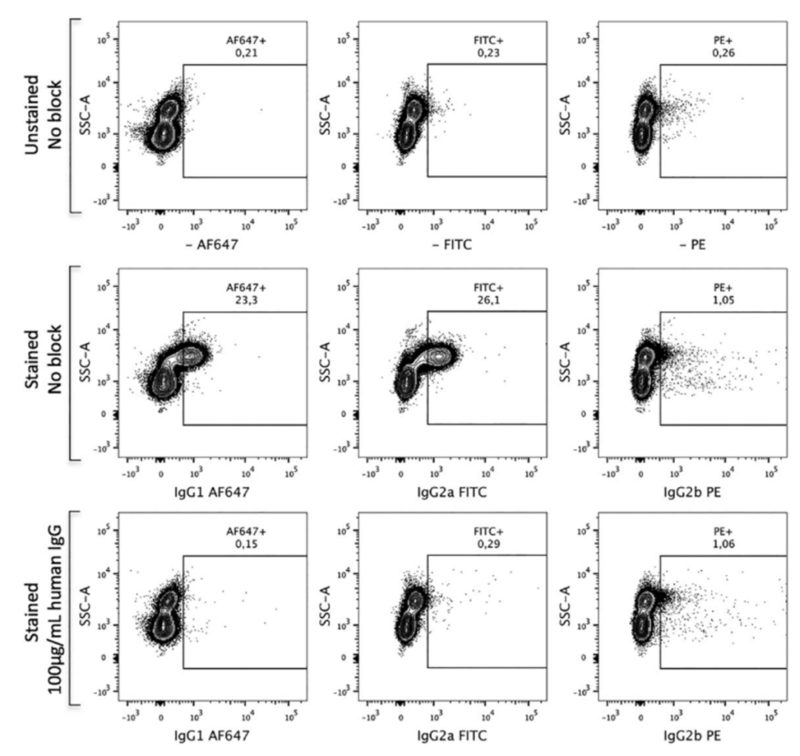
Researches show isotype control for solving non-specific antibody binding with cells is restricted. First, during obvious non-specific binding, isotype control can't accurately distinguish and select target group; Second, isotype control shows inconsistent binding ability among different experimental batches and donors, affecting reproducible results. Finally, compared with isotype control, blocking Fc receptor can reduce non-specific binding more efficiently. Thus, isotype control isn't the best alternative choice for Fc block.
4. Notes
Due to limitations of species and concentration, FBS or BSA in the staining solution can't completely block non-specific binding. Fc blockers should be added before antibody staining to efficiently block Fc receptor. Blocking with homologous serum or IgG may disturb antibody staining effects.
| Recommended Products |
||
| Product Category | Product Name | Cat.No |
| Erythrocyte Lysis Buffer | 10x ACK Lysis Buffer(without fixative) | K080 |
| Buffer | Cell Staining Buffer | K079 |
| Nuclear Staining | PI Reagent | K116 |
| 7-AAD Reagent | K115 | |
| DAPI Reagent | K117 | |
| Stimulating and Blocking | Cell Stimulation and Protein Transport Inhibitor Kit | K083 |
| Fixation/Permeabilization | Foxp3/Transcription Factor Staining Kit | K081 |
| Intracellular Fixation/Permeabilization Buffer Kit (Ready To Use) | K082R | |
| FcR Blocking | Purified Anti-Mouse CD16/32 Antibody | FNab30106 |
| Purified Anti-Human CD16 Antibody | FNab10997 | |
| Viability Dye | Calcein AM/PI Live/Dead Double Staining Kit | FNCK022 |
| FineTest® Red 780(Viability Dye) | K121 | |
| FineTest®Violet 510(Viability Dye) | K124 | |
| Recommended Products | |||
| Species | Cell Populations | Flow Cytometry Antibody Combination | Cat.No |
| Human | T/B/NK cell populations detection | CD45-PerCP | PCP-30039 |
| CD3-FITC | FITC-30004 | ||
| CD16-PE | PE-30061 | ||
| CD56-PE | PE-30008 | ||
| CD19-APC | APC-30066 | ||
| Human | Thl/Th2 cell populations detection | CD3-PerCP/Cyanine5.5 | PCP55-30004 |
| CD4-FITC | FITC-30005 | ||
| IFN-γ-PE | PE-30053 | ||
| IL4-APC | APC-30043 | ||
| Mouse | Thl/Th2 cell populations detection | CD3-PerCP/Cyanine5.5 | PCP55-30002 |
| CD4-FITC | FITC-30128 | ||
| IFN-γ-PE | PE-30074 | ||
| IL4-APC | APC-30026 | ||
| Human | Treg cell populations detection | CD4-FITC | FITC-30005 |
| CD25-PE | PE-30035 | ||
| CD3-PerCP-Cy5.5 | PCP55-30004 | ||
| CD127-FineTest®647 | F647-30033 | ||
| Mouse | Treg cell populations detection | CD4-FITC | FITC-30128 |
| CD25-APC | APC-30017 | ||
| FOXP3-PE | PE-30111 | ||
REFERENCES
[1]Reducing IgG accumulation via neonatal Fc receptor (FcRn) blockade relieves neuropathic pain, PMID: 39870199.
[2]Aptamers Generated by Multi-Strategy Selection Target FcγRI and Block IgG Fc-FcγRI Interaction, PMID: 41355772.