


Abstract: Pathogens across body barrier will be subject to innate immune defense of complement system. Complement is the soluble protein in body fluid, and named for its contribution to antibody sterilization. Activation of antibody-dependent / independent pathway promotes clearance and phagocytosis of pathogens. Defensive roles in early infection are important. Besides anti-infection, complement is also involved in neurodevelopment, synaptic pruning, damage repair and homeostasis maintenance of nervous system. However, abnormal activation may induce neurological disorders.
Keywords: Complement system, Complement pathway, Complement activation, Targeted therapy
1. Components of the Complement System
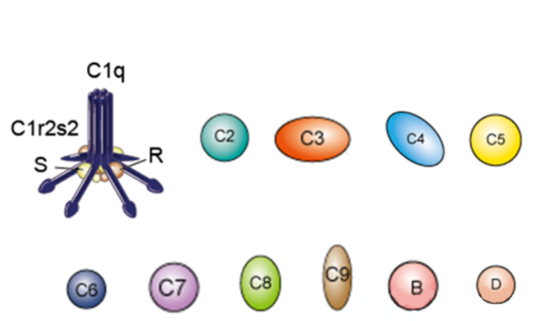
Complement system consists of 50 soluble and membrane-binding proteins, showing the complexity of limited proteolysis system. Complement in serum is usually inactive, taking effects via activation. Three types of complement system include: 1. involvement in innate component of cascade activation, e.g. involvement of C1-C9, B, D, P factor and MBL-associated proteins in classical, alternative or lectin pathway. C5-C9 is the common terminal pathway molecule; 2. Regulation of protein activation is controlled via soluble or membrane-binding form, e.g. C1INH, H factor, DAF, CD59 etc; 3. Complement receptors mediate biological effects of complement fragments.
2. Three Pathways of Complement Activation
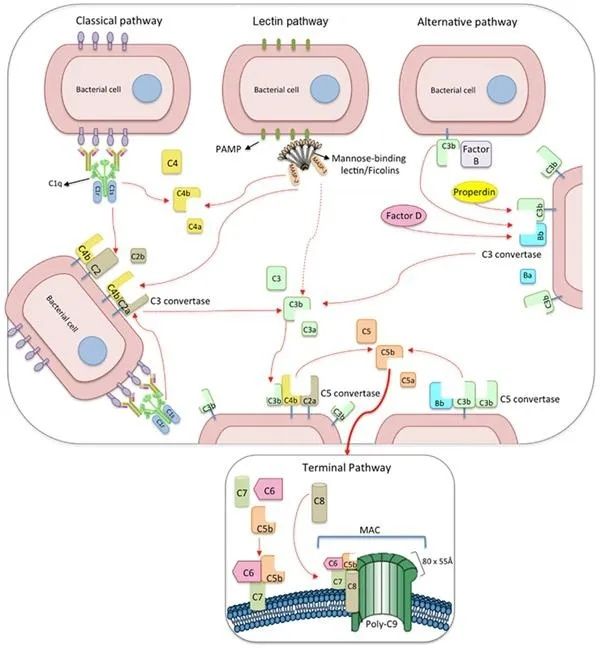
Activation of the complement system includes classical, alternative and lectin pathway. Classical pathway is triggered by antigen-antibody complex. C1q recognizes and binds with Fc region of immunoglobulin(IgM or IgG). Ca²⁺ dependence activates C1r and C1s. Activated C1s lyses C4 and C2 respectively, producing C4b2a(C3 convertase) to lyse C3 into C3a and C3b. Binding between C3b and C4b2a forms C5 convertase(C4b2a3b), initiating membrane attack phase. Antibody-independent alternative pathways are directly activated by pathogen surface(e.g. bacterial lipopolysaccharide, fungus etc). Spontaneous hydrolysis of C3 in physiological conditions produces C3b. Mg²⁺ helps the binding with factor B. Factor D-mediated cleavage produces C3bBb(alternative C3 convertase). Factor P can stabilize the enzyme. Cleavage of C3 mediated by this enzyme forms a positive feedback amplification loop. Finally, C3bBb3b(C5 convertase) is produced. Lectin pathway is initiated by mannose-binding lectin(MBL) or ficolin-mediated recognition of surface sugar structure of pathogens. Serine protease MASP-2-mediated cleavage of C4 and C2 produces C4b2a. Activation of C3 by MASP-1 converges to a common terminal pathway. Three pathways finally result in assembly of membrane attack complex(MAC) by C5~C9, mediating lysis of the target cell.
3. Biological Effects of Activated Complement
Biological functions of activated complement are various: First, three pathways form membrane attack complex(MAC). Membrane perforation of pathogen results in cleavage and death; Second, C3b produced during cleavage can bind with surface of pathogen, converting to iC3b. Recognition of opsonin by complement receptor on the surface of phagocytes obviously improves phagocytic clearance for pathogen. Besides, soluble complement fragments(e.g. potent chemoattractants: C3a, C5a) exist in the body fluid. Recruitment and activation of immunocytes(e.g. macrophage, neutrophil etc) enhances migration and phagocytosis ability, thereby synergistically removing pathogen.
4. Complement-Targeted Drugs and Therapies
Pathogenic effects of complement system in various diseases show therapeutic significance of effector. In recent years, various complement inhibitors are generally available. In 2007, the anti-C5 monoclonal antibody eculizumab(Soliris) was approved for paroxysmal nocturnal hemoglobinuria(PNH). Then, C1 inhibitor(Cinryze) was used for hereditary angioedema. In 2018, long-acting C5 inhibitor ravulizumab(Ultomiris) was approved. Dosing interval of every 8 weeks improve patient compliance. C3 inhibitor pegcetacoplan(EMPAVELI™) was used for treatment of PNH and geographic atrophy. C1s inhibitor sutimlimab(Enjaymo™) was the first approved drug for cold agglutinin disease. In 2023, C5 inhibitor avacincaptad pegol(IZERVAY™) was approved for treatment of geographic atrophy, providing new solution for age-related macular degeneration.
|
|
||
|
|
|
|
|
|
|
|
|
|
|
|
|
|
|
|
|
|
|
|
|
|
|
|
|
|
|
|
|
|
|
|
|
|
|
|
|
|
|
|
|
|
|
|
|
|
|
|
|
|
|
|
|
|
|
|
|
|
|
|
|
|
|
|
|
|
|
|
|
|
|
|
|
|
|
|
|
|
|
|
|
|
|
|
|
|
|
|
|
|
|
|
|
|
|
|
|
|
|
|
|
|
|
|
|
|
|
|
|
|
|
|
|
|
|
|
|
|
|
|
|
|
|
|
|
|
|
|
|
|
|
|
|
|
|
|
|
|
|
|
|
|
|
|
|
|
|
|
|
|
|
|
|
|
|
|
|
|
|
|
|
|
|
|
|
|
|
|
|
|
|
|
|
|
|
|
|
|
|
|
|
|
|
|
|
|
|
|
|
|
|
|
|
|
|
|
|
|
|
|
|
|
|
|
|
|
|
|
|
|
|
|
|
|
|
|
|
|
|
|
|
|
|
|
|
|
|
|
|
|
|
|
|
|
|
|
|
|
|
|
|
|
|
|
|
|
|
|
|
|
|
|
|
|
|
|
|
|
|
|
|
|
|
|
|
|
|
|
|
|
|
|
|
|
|
|
|
|
|
|
|
|
|
|
|
|
|
|
|
|
|
|
|
|
|
|
|
|
|
|
|
|
|
|
|
|
|
|
|
|
|
|
|
|
|
|
|
|
|
|
|
|
|
|
|
|
|
|
|
|
|
|
|
|
|
|
|
|
|
|
|
|
|
|
|
|
|
|
|
|
|
|
|
|
|
|
|
|
|
|
|
|
|
|
REFERENCES
[1]Complement system-mediated immunomodulation in epilepsy: From pathogenesis to therapeutic opportunities, PMID: 42269875.
[2]The life-and-death struggle between the complement system and pathogens: Mechanisms of elimination, evasion tactics, and translational potential, PMID: 40905313.