


Abstract: During flow cytometry analysis of immunology, CD45 marker is nearly used in each antibody combination. As the common antigen of leukocytes, CD45 is widely expressed on the surface of hematopoietic derived leukocytes. Roles in differentiating immune cells and non-immune cells are very important. CD45 is the gating marker required for immunophenotype, tumor microenvironment analysis and identification of tissue-resident immunocyte. Using with other surface markers(e.g. CD3, CD4, CD8, CD19 etc) together can precisely differentiate various immune cell subpopulations(e.g. T-, B-, NK-cell, monocytes etc). Thus, CD45 plays an important role in immunological research.
Keywords: CD45 Marker, Flow Cytometry Gating, Immunophenotype, Cell Identification
1. Applications of CD45 in Flow Cytometry
Wide applications of CD45 in flow cytometry depend on high expression in all leukocytes, strong signal, high stability, and less interferences in regular sample processing. Due to these features, CD45 is the general marker for leukocyte recognition. Applications include gating strategy, analysis for immune cell subpopulations and sample QC etc. Thus, CD45 is the essential marker in flow cytometry design.
- Tumor Microenvironment: Distinguish CD45⁻ tumor cell and CD45⁺ infiltrated immunocyte. Accurately evaluate level of immune infiltration.
- Peripheral Blood Analysis: Rapidly recognize CD45⁺ leukocytes. Perform immunophenotype of T-, B-, and NK-cell subpopulations with other markers(e.g. CD3, CD19 etc). Gating for lysed erythrocytes is still stable.
- Tissue-resident immunocyte: CD45 can differentiate immunocytes and CD45⁻ parenchymal cells in tissues(e.g. spleen, lung, liver), recognizing specific populations e.g. alveolar macrophages(CD45⁺, CD11c⁺), Kupffer cells.
- Immunotherapeutic efficacy evaluation: Compare proportion of CD45⁺ cells and subpopulations(e.g. CD8⁺, T cell, Treg) before and after treatment to dynamically monitor immune response.
- Research on hematopoietic differentiation: CD45 is the typical molecule for identifying immune cells produced by differentiation. Removal of undifferentiated stem cells with CD45⁻ ensures differentiation efficiency and accurate evaluation.
2. Roles of CD45 in Flow Cytometry
Gating: As the leukocyte marker, CD45 can effectively differentiate positive immune cells(CD45+) and negative tumor cells, erythrocytes, stromal cells(CD45-). Immune populations in tissue samples can be rapidly selected.
Immunophenotype: CD45 expression intensity in different immune cell subpopulations is also varied. E.g. mature lymphocytes are CD45+ positive cells. Myeloid-derived suppressor cells(MDSCs) are CD45^dim. Using with other markers(e.g. CD3, CD19) can achieve accurate immunophenotype. Recognize immunosuppressive populations in tumor microenvironment.
Quality Control: Signal of CD45 is highly stable. The positive ratio can evaluate sample quality. Abnormally low ratio indicates cell degradation, excessive digestion or pollution, providing reliable experimental guidance. Detection with strong fluorescence channel can ensure correct gating.
3. Effects Induced by Deficiency of CD45
Deficiency of CD45 during gating will obviously affect accuracy and reliability of flow cytometry analysis. First, dependence on FSC/SSC easily misjudges non-leukocytes(e.g. tumor cells, debris) as immune cells. Thus, level of immune infiltration is overestimated. Second, accurate grouping based on CD45⁺ is impossible. Identification of subpopulations(e.g. T cell, B cell, myeloid cell, CD45^dim MDSC) is distorted, affecting data analysis. Besides, CD45 is the standard marker of immunological research. Deficiency of CD45 causes inconsistent gating evidence, poor reproducibility and difficult comparison with general databases(ImmGen, FlowRepository) or citations. Data sharing and comparison are restricted. Thus, CD45 can ensure accurate analysis and its key roles in standardization and reproducible research.
4. Significance of CD45 in Gating
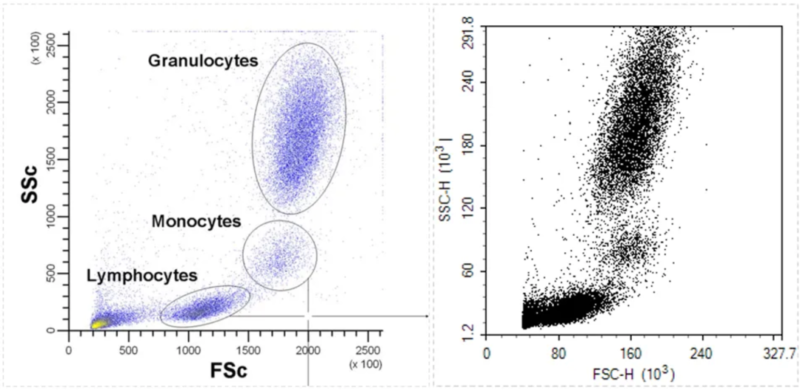
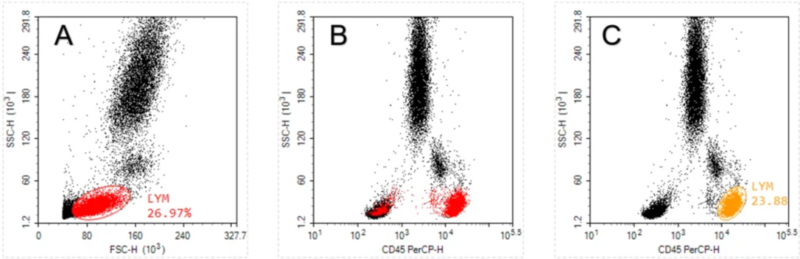
As shown in figures below, the figure(left) is the ideal FSC/SSC scatter diagram, distinctly distinguishing different cell populations. However, samples produce a large number of debrises due to improper processing or cell death, resulting in complex situations(right) e.g. diffuse cell distribution, fuzzy lymphocytic boundary, inaccurate gating. Dependence of FSC/SSC easily misjudges. Gating with surface markers(e.g. CD45) can effectively recognize true immune cells. Removal of debris interference can improve analytical accuracy.
Blind gating with FSC/SSC(A) easily misjudges cell debrises or non-specific particles as lymphocyte population(B), resulting in analytical deviation. Gating with CD45 and SSC(C) can precisely recognize leukocytes based on signal of CD45⁺. Efficient removal of CD45⁻ debris interference can help define true lymphocyte population.
| Recommended Products | |||
| Species | Cell Populations | Flow Cytometry Antibody Combination | Cat.No |
| Human | T/B/NK cell populations detection | CD45-PerCP | PCP-30039 |
| CD3-FITC | FITC-30004 | ||
| CD16-PE | PE-30061 | ||
| CD56-PE | PE-30008 | ||
| CD19-APC | APC-30066 | ||
| Human | Thl/Th2 cell populations detection | CD3-PerCP/Cyanine5.5 | PCP55-30004 |
| CD4-FITC | FITC-30005 | ||
| IFN-γ-PE | PE-30053 | ||
| IL4-APC | APC-30043 | ||
| Mouse | Thl/Th2 cell populations detection | CD3-PerCP/Cyanine5.5 | PCP55-30002 |
| CD4-FITC | FITC-30128 | ||
| IFN-γ-PE | PE-30074 | ||
| IL4-APC | APC-30026 | ||
| Human | Treg cell populations detection | CD4-FITC | FITC-30005 |
| CD25-PE | PE-30035 | ||
| CD3-PerCP-Cy5.5 | PCP55-30004 | ||
| CD127-FineTest®647 | F647-30033 | ||
| Mouse | Treg cell populations detection | CD4-FITC | FITC-30128 |
| CD25-APC | APC-30017 | ||
| FOXP3-PE | PE-30111 | ||
REFERENCES
[1]Validation of a candidate international harmonisation protocol-compliant measurement procedure for reticulocyte counting using an erythrocyte gating strategy excluding the platelet component, PMID: 41235751.
[2]Assessment of inter-operator variability in peripheral monocyte subset gating strategy using flow cytometry in patients with suspected acute stroke, PMID: 37971361.