


Abstract: Tandem dyes consist of covalently-bonded donor and acceptor fluorescent molecule, transferring energy to expand fluorescent choice of flow cytometry via FRET effects. Applications are wide but stability is poor. FRET efficiency is lower than 100%, often accompanied with fluorescent leakage in donor(e.g. PE signal in PE-Cy7). Besides, illumination or oxygen radicals can destroy acceptor molecule, leading to FRET invalidity and irreversible inactivation of dyes. Thus, compensation regulation and quality control are required in the assay.
Keywords: Tandem dyes, Flow Cytometry, Fluorescence Resonance Energy Transfer(FRET)
1. Principle of Tandem Dyes
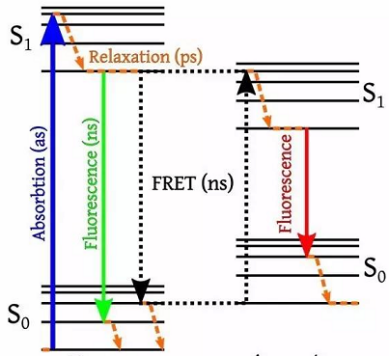
Fluorescence resonance energy transfer(FRET) is the non-radiative energy transfer process, happening within 1-10 nm between the donor and acceptor fluorescent molecule. Energy transfer from exciteded donor to acceptor can enable fluorescence emission of acceptor at specific wavelength. Efficiency of FRET depends on the distance and spectral overlap. Tandem dyes are designed based on FRET principle, offer various choices for fluorescent labeling, and are widely applied in multicolor flow cytometry analysis.
2. Stability of Tandem Dyes
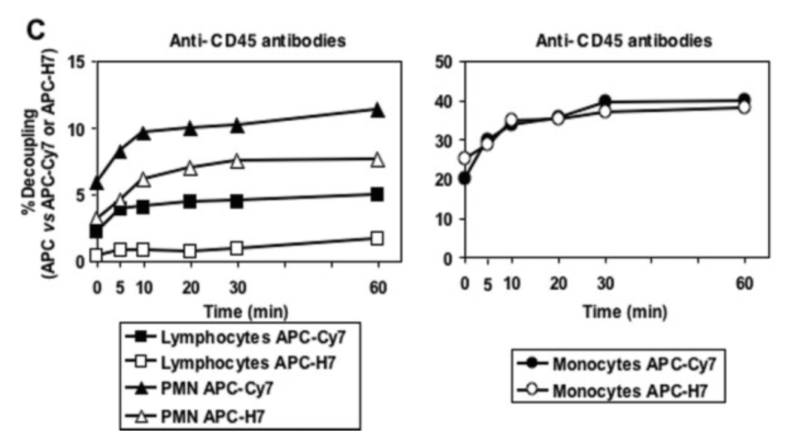
The stability of tandem dyes is affected by various factors. Illumination can damage covalent bond among donor and acceptor, resulting in uncoupling and irreversible degradation. Thus, use and store in the dark. Higher temperature or acute change denatures fluorescent molecule. It's suggested to operate under low temperature condition. Besides, shelf life of tandem dyes is short. Long-time fixation or permeabilization can accelerate degradation. Thus, fixation duration should be controlled and tested in time. The active metabolism of some cells(e.g. monocytes, macrophages) easily degrades tandem dyes. Although the risk of degradation exists, signal interference can be efficiently decreased via optimization of panel design, stabilizer and proper fluorescent combination. High-to-low degradation rate among different cells is monocytes > granulocytes > lymphocytes.
3. How to Prevent or Decrease Degradation of APC-Tandem Dyes
If living cells are not required, fixation of cells after staining can terminate metabolic activity. Pilot assay is required to verify whether fixation obviously affects the target before use.
a. Staining at 4°C can slow down metabolism and decrease degradation of tandem dyes further.
b. Addition of sodium azide during staining can inhibit cellular metabolism, decelerating degradation of dyes.
c. Addition of vitamin C as antioxidant can prevent oxidation-induced dye damage.
Methods above can improve stability and detection accuracy.
4. Applications
Tandem dyes are widely applied in flow cytometry, due to obvious improvement for multicolor detection. Donor dyes excited by different lasers can synchronously recognize multiple target molecules. Common donors are phycoerythrin(PE) and allophycocyanin(APC). Take PE-Cy5 for example, energy is transferred to Cy5 after excitation of PE. Detection of emission light can effectively distinguish different cell populations.
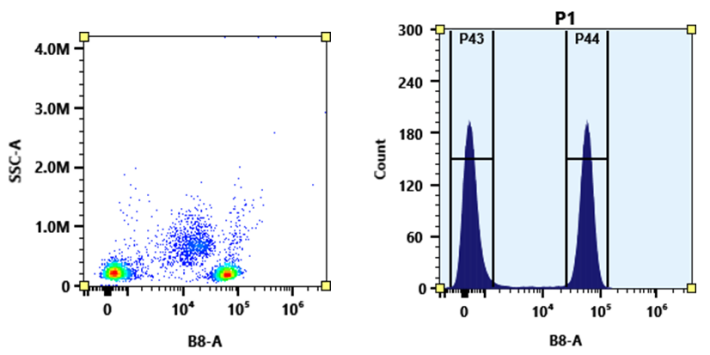
Tandem dyes can expand fluorescent channels and improve multicolor detection. High dimensional analysis with limited device configuration enhances experimental flexibility and signal differentiation.
| Recommended Products | |||
| Species | Cell Populations | Flow Cytometry Antibody Combination | Cat.No |
| Human | T/B/NK cell populations detection | CD45-PerCP | PCP-30039 |
| CD3-FITC | FITC-30004 | ||
| CD16-PE | PE-30061 | ||
| CD56-PE | PE-30008 | ||
| CD19-APC | APC-30066 | ||
| Human | Thl/Th2 cell populations detection | CD3-PerCP/Cyanine5.5 | PCP55-30004 |
| CD4-FITC | FITC-30005 | ||
| IFN-γ-PE | PE-30053 | ||
| IL4-APC | APC-30043 | ||
| Mouse | Thl/Th2 cell populations detection | CD3-PerCP/Cyanine5.5 | PCP55-30002 |
| CD4-FITC | FITC-30128 | ||
| IFN-γ-PE | PE-30074 | ||
| IL4-APC | APC-30026 | ||
| Human | Treg cell populations detection | CD4-FITC | FITC-30005 |
| CD25-PE | PE-30035 | ||
| CD3-PerCP-Cy5.5 | PCP55-30004 | ||
| CD127-FineTest®647 | F647-30033 | ||
| Mouse | Treg cell populations detection | CD4-FITC | FITC-30128 |
| CD25-APC | APC-30017 | ||
| FOXP3-PE | PE-30111 | ||
REFERENCES
[1]Novel PE and APC tandems: Additional near‐infrared fluorochromes for use in spectral flow cytometry, PMID: 35112484.
[2]Rapid Light-Dependent Degradation of Fluorescent Dyes in Formulated Serum-Free Media, PMID: 31843785.
[3]Increasing Signal Intensity of Fluorescent Oligo-Labeled Antibodies to Enable Combination Multiplexing, PMID: 38889324.